
Slip and fall accidents happen more often than people think, with over 3 million emergency department visits annually according to the National Safety Council. A wet grocery store floor, uneven sidewalk, or poorly lit stairway can quickly cause serious injuries. While these incidents may look minor at first, they can lead to long-term medical costs, lost income, and legal disputes.
What Is a Slip and Fall Accident?
A slip and fall accident occurs when a person is injured due to a hazardous condition on someone else’s property. These cases fall under personal injury law and are based on negligence.
Common Locations
- Grocery stores and retail shops
- Restaurants and hotels
- Parking lots and sidewalks
- Apartment buildings
- Private homes
Common Hazards
- Wet or freshly mopped floors
- Loose rugs or torn carpeting
- Uneven pavement or steps
- Ice, snow, or debris
- Poor lighting or broken handrails
Property owners and managers are generally responsible for keeping these areas reasonably safe.
The Legal Basis of a Slip and Fall Claim
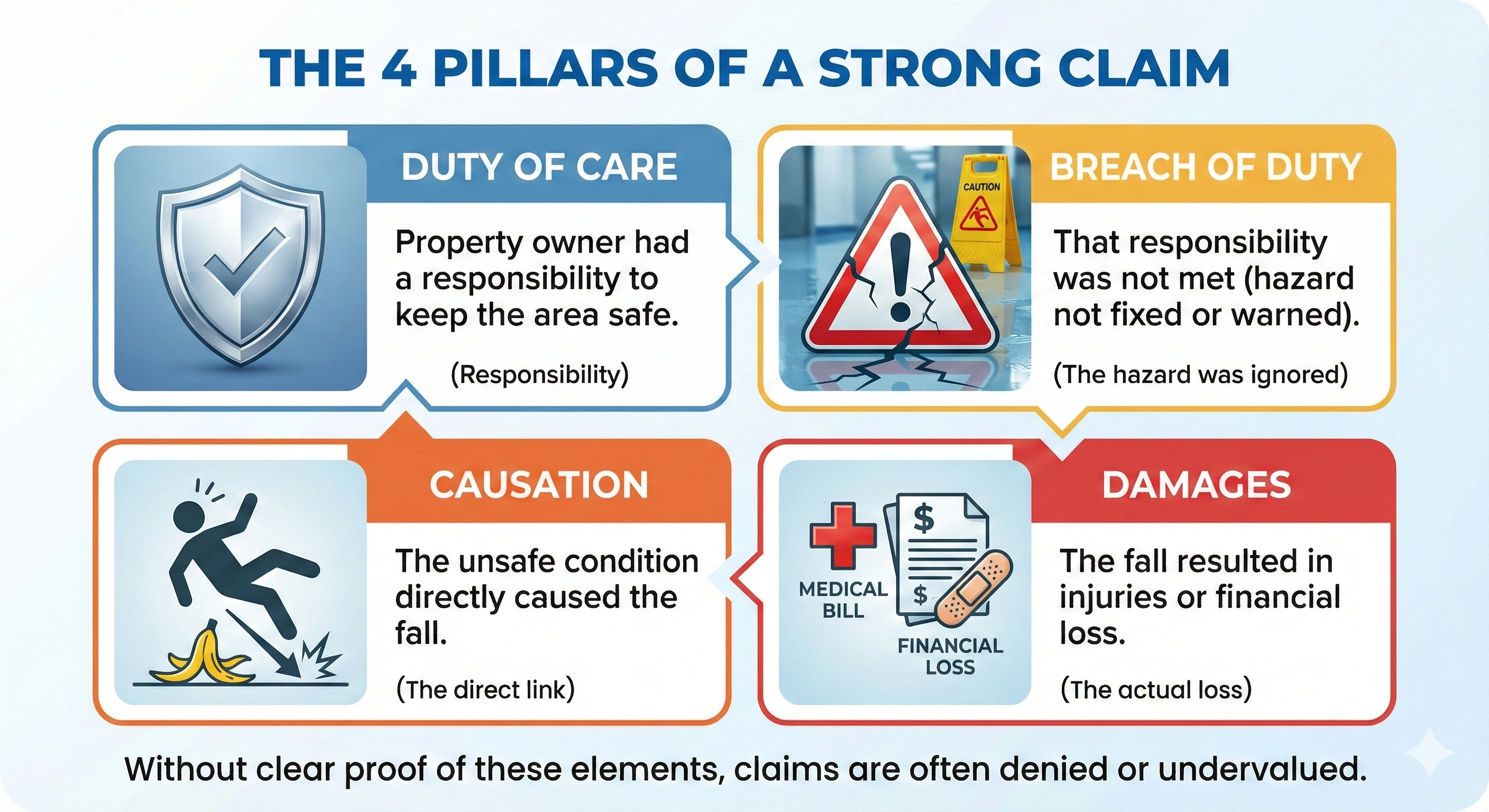
To succeed in a slip and fall case, four legal elements of negligence must be established:
- Duty of Care – The property owner had a responsibility to keep the area safe.
- Breach of Duty – That responsibility was not met (hazard not fixed or warned).
- Causation – The unsafe condition directly caused the fall.
- Damages – The fall resulted in injuries or financial loss.
Without clear proof of these elements, claims are often denied or undervalued.
Immediate Steps After a Fall
Your actions after the accident can strongly affect the outcome of a claim.
- Seek Medical Care: Establish a professional medical record of your injuries immediately; delays can be used by insurance companies to question the claim's validity.
- Document the Scene: Take photos of the hazard (e.g., wet floor, ice, or uneven surface), the surrounding area, and any nearby cameras.
- Report the Incident: File an official accident report with the property owner or manager before leaving the scene.
- Gather Witness Info: Collect contact details from anyone who saw the fall or the hazardous condition.
- Avoid Giving Statements: Do not give recorded statements to insurance adjusters before consulting a lawyer, as these are often used to undermine your case.
How Slip and Fall Cases Are Proven
Slip and fall claims rely heavily on evidence. Insurance companies often argue that the hazard was obvious or that the injured person was careless.
Evidence That Strengthens a Case
- Photos or video of the dangerous condition
- Surveillance footage
- Maintenance or cleaning logs
- Witness statements
- Medical documentation
The stronger the proof, the better the chance of a fair settlement.
Are Slip and Fall Cases Hard to Win?
Slip and fall cases are not automatically difficult, but they do require solid proof. Many cases fail because:
- Evidence was not collected early
- Medical care was delayed
- Fault was admitted too soon
Cases with clear hazards, documented injuries, and consistent medical treatment tend to resolve more successfully.
Understanding Legal Fees and Case Value
Most slip and fall cases are handled on a contingency fee basis, meaning there are no upfront legal costs. Injury lawyers typically charge 25%–40% of the final settlement, and fees are only paid if compensation is recovered.
Settlement value depends on medical costs, lost income, injury impact, and strength of liability evidence. Many cases fall between $10,000 and $60,000, while serious injuries may result in higher compensation.
Factors That Affect Compensation
- Medical expenses (past and future)
- Lost wages and reduced earning capacity
- Pain and suffering
- Long-term disability
- Shared fault (comparative negligence)
There is no universal payout amount—each case is unique.
Read More: https://www.remotecasemanager.com/blogs/are-personal-injury-settlements-taxable
Common Mistakes That Reduce Compensation
Avoid these errors that can weaken a claim:
- Delaying medical treatment
- Failing to document the accident
- Posting about the incident on social media
- Giving recorded statements without legal advice
- Accepting early settlement offers
Insurance companies often use these mistakes to minimize payouts.
Slip and Fall Accidents at Private Residences
Many people assume falls at private homes do not qualify for claims. That is not always true.
You may still have a valid claim if:
- The homeowner knew about the hazard
- The hazard existed long enough to be fixed
- No warning was provided
These cases often involve homeowner’s insurance and require careful legal evaluation.
How Legal Support Helps Slip and Fall Claims
Slip and fall cases often involve disputed liability, insurance resistance, and strict legal standards. A personal injury lawyer follows a structured process to build a strong claim and pursue fair compensation.
Key steps typically include:
- Investigation
Gathering evidence such as accident scene photos, witness statements, incident reports, surveillance footage, and medical records. - Legal Analysis
Reviewing the facts to confirm negligence, determine liability, and assess the full scope of damages. - Demand Letter
Submitting a formal compensation demand to the property owner or insurance carrier outlining liability, injuries, and financial losses. - Negotiation
Engaging with insurers to reach a settlement that reflects the severity of injuries, medical costs, and long-term impact. - Litigation (If Necessary)
Filing a civil lawsuit and preparing the case for trial if settlement negotiations fail to produce fair compensation.
.webp)
Working with a lawyer experienced in slip and fall cases allows injured individuals to focus on recovery while legal strategy, documentation, and negotiations are handled professionally. Throughout the process, clients receive guidance and clarity at each stage of their case.
Why Timing and Preparation Matter
Slip and fall accidents can have serious financial and physical consequences. While these cases may seem simple, they often involve complex legal standards and aggressive insurance defenses.
Acting quickly, documenting thoroughly, and understanding your rights can make a significant difference in the outcome of a claim.
How Law Firms Benefit From Remote Case Manager
Remote Case Manager helps personal injury law firms handle slip and fall cases more efficiently while reducing overhead and maintaining strict compliance.
Law firms benefit from:
- HIPAA-compliant case management that protects sensitive client data
- Pre-vetted, PI-specialized case managers with years of experience
- Bilingual support to improve client communication
- Advanced legal software proficiency for faster, more accurate case handling
- Access to top 1% PI case managers worldwide, without hiring overhead
Proven Results for Growing Law Firms
- 10× increase in productivity and case handling capacity
- 90% improvement in operational efficiency
- 40% reported annual profit growth from reduced costs and streamlined workflows
Frequently Asked Questions
Are slip and fall cases hard to win?
Slip and fall cases can be challenging, but strong evidence and medical records greatly improve success. Clear hazards and documented injuries often lead to settlements.
What not to say to an injury lawyer?
Avoid admitting fault, guessing causes, or minimizing injuries. Stick to facts so your lawyer can assess liability accurately and protect your claim.
How much are most slip and fall settlements?
Most slip and fall settlements range from $10,000 to $50,000, though severe injuries or strong evidence can significantly increase compensation.
How much compensation do you get for a fall?
Compensation depends on medical costs, lost income, injury severity, and long-term impact. There is no fixed amount for all cases.
Can I still file a claim if my fall happened at a private residence?
Yes. If the homeowner’s negligence caused the hazard and injury, a claim may be filed through homeowner’s insurance.









.webp)




.webp)


%20(1).webp)





















%20(2)%20(2).avif)
.avif)