
Modern law firms operate under constant pressure, tight deadlines, strict compliance requirements, and growing client expectations. Attorneys are expected to deliver high-quality legal work while managing heavy administrative demands. This is where a legal administrative assistant, often working alongside a legal assistant or attorney, becomes essential.
In remote law firms, this role has evolved beyond basic clerical work. Today, these professionals provide legal-trained, U.S. law-experienced administrative support that keeps firms organized, responsive, and operationally efficient, without the overhead of in-house hiring.
What Is a Legal Administrative Assistant?
A legal administrative assistant supports attorneys and legal teams by managing the administrative and operational tasks that allow lawyers, legal assistants, and assistant lawyers to focus on legal strategy, casework, and client advocacy.
Unlike paralegals or an entry level legal assistant focused on legal drafting support, this role does not provide legal advice or prepare substantive legal arguments. Their role centers on administrative coordination, communication, and operational support that keeps legal teams functioning efficiently.
In remote law firms, these responsibilities are handled using secure digital tools and standardized workflows, making this support function a core part of modern legal practice.
Why Remote Law Firms Rely on Administrative Legal Support
Legal industry research shows that attorneys spend a significant portion of their workweek on administrative tasks, reducing the time available for billable legal work.
Remote administrative support solves this by:
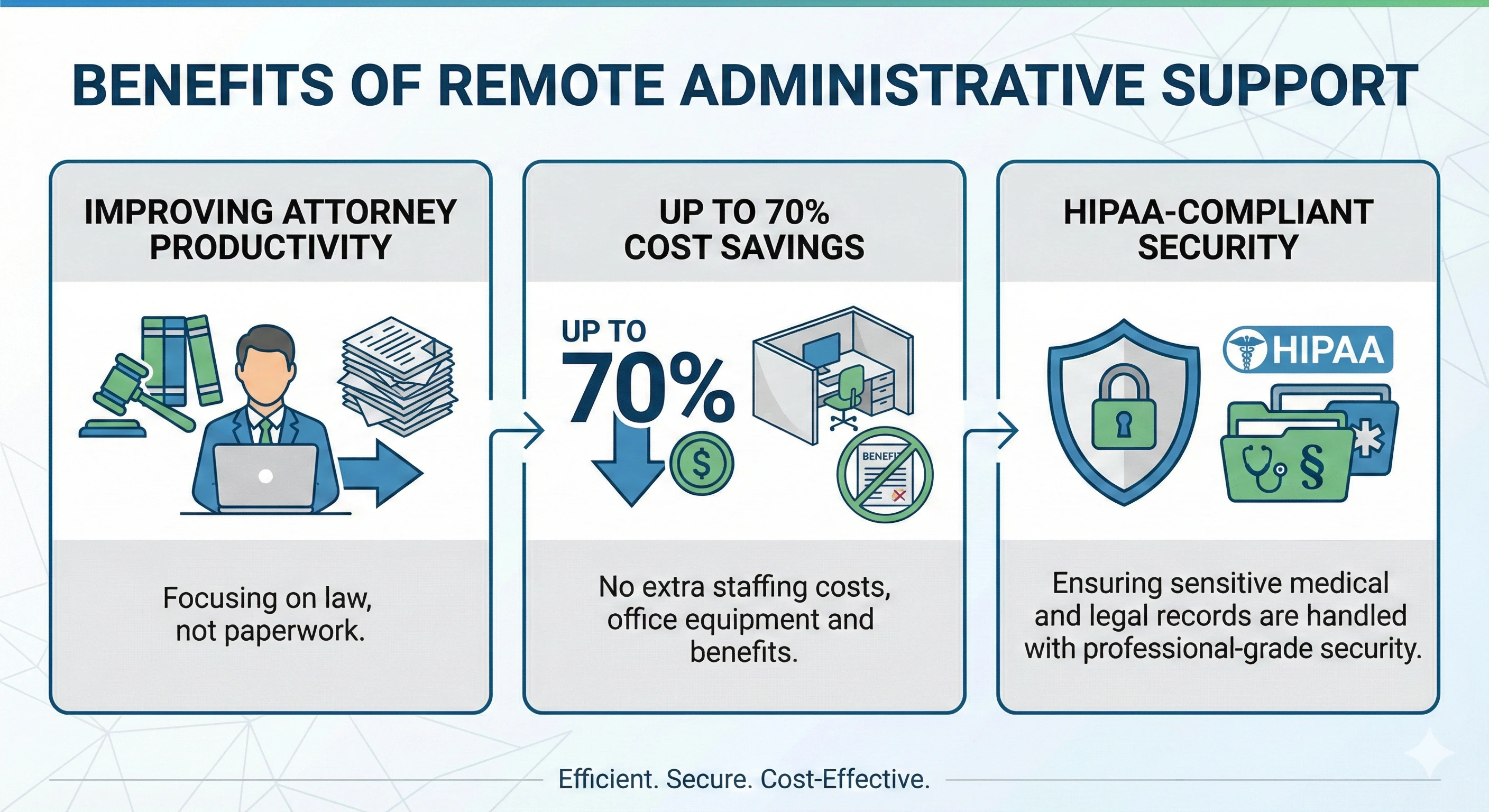
- Improving Attorney Productivity: Focusing on law, not paperwork.
- Up to 70% Cost Savings: No extra staffing costs, office equipment and benefits.
- HIPAA-Compliant Security: Ensuring sensitive medical and legal records are handled with professional-grade security.
By outsourcing administrative work to pre-vetted, U.S. law-experienced professionals, law firms gain reliable support without compromising quality or confidentiality.
Core Responsibilities in Remote Legal Administrative Support
Law firms depend on administrative assistants to handle a wide range of responsibilities that support attorneys, legal assistants, and assistant lawyers across daily legal operations. Below are the ten essential duties that define the role.
1. Calendar Management
Legal work is deadline-driven. Missed court dates, late filings, or overlapping meetings can create serious consequences for a law firm.
This role manages attorney calendars by organizing court appearances, client meetings, internal deadlines, and reminders. This ensures attorneys stay on schedule and prepared for every commitment.
In remote law firms, calendar management often includes coordinating across time zones and syncing multiple calendars to maintain visibility and accountability.
Benefit to law firms: fewer scheduling errors, stronger deadline control, and smoother daily operations.
2. Email Management
Law firms receive a high volume of emails daily—from clients, courts, opposing counsel, and internal teams. Without proper management, important messages can be missed or delayed.
Administrative support staff filter, organize, and prioritize emails so attorneys can focus on urgent and high-value communications. Routine correspondence is handled efficiently, while time-sensitive messages are flagged promptly.
In remote environments, effective email management supports responsiveness and professionalism across all client interactions.
Benefit to law firms: improved communication flow and faster response times.
3. Document Management
Legal practices generate large volumes of documents, including pleadings, contracts, discovery files, correspondence, and internal records.
This administrative support function ensures documents are properly filed, labeled, secured, and easily retrievable. This includes maintaining digital filing systems, version control, and confidentiality standards.
Efficient document management supports faster case preparation and reduces the risk of lost or misfiled information.
This includes secure systems and HIPAA-compliant remote support to protect sensitive client information.
Federal compliance guidance emphasizes the importance of secure systems, access controls, and confidentiality standards when handling sensitive client information.
Benefit to law firms: organized records, secure data handling, and improved workflow efficiency.
4. Client Intake Processing
First impressions matter. Legal administrative assistants often serve as the first point of contact for prospective clients.
They manage intake forms, gather preliminary information, schedule consultations, and ensure attorneys are prepared for initial meetings. This structured intake process creates a smooth onboarding experience for new clients.
In remote law firms, intake workflows are streamlined through digital forms and secure communication channels.
Benefit to law firms: stronger client experience and better-prepared consultations.
5. Billing and Invoicing Support
Accurate billing is critical to a law firm’s financial health. Administrative assistants support billing by preparing invoices, tracking billable activities, and monitoring payments.
They also assist with follow-ups on outstanding invoices, helping firms maintain steady cash flow without pulling attorneys away from legal work.
Remote administrative legal professionals are often trained to work within billing software and time-tracking systems used by U.S. law firms.
Benefit to law firms: consistent revenue management and reduced administrative burden.
6. Data Entry and Case Record Maintenance
Case management systems rely on accurate, up-to-date information. Legal administrative assistants handle data entry related to cases, clients, deadlines, and documents.
Accuracy is essential. Proper data entry ensures attorneys can quickly access the information they need when preparing for hearings, meetings, or filings.
In remote settings, assistants follow standardized workflows to maintain data integrity across systems.
Benefit to law firms: reliable records and efficient case tracking.
7. Travel Coordination
Attorneys frequently travel for court appearances, depositions, conferences, or client meetings. Coordinating travel logistics can be time-consuming.
Legal administrative assistants manage travel arrangements, accommodations, and schedules so attorneys can focus on their work instead of logistics.
In remote law firms, this coordination is handled digitally and aligned with case schedules and firm policies.
Benefit to law firms: reduced disruptions and better time management for attorneys.
8. Meeting Coordination
Legal work depends on effective communication. Administrative assistants schedule internal meetings, client calls, and virtual conferences.
They ensure participants are informed, prepared, and able to join without technical or scheduling issues. In remote law firms, this includes managing video conferencing tools and shared calendars.
Benefit to law firms: smoother collaboration and more productive meetings.
9. Drafting Correspondence
Clear, professional communication is essential in the legal field. Legal administrative assistants draft emails, letters, notices, and routine correspondence on behalf of attorneys.
This ensures consistency in tone, accuracy in messaging, and timely communication with clients and partners.
In remote firms, correspondence drafting follows firm-approved templates and communication standards.
Benefit to law firms: polished communication and consistent client interactions.
10. Legal Research Assistance
While legal administrative assistants do not provide legal advice, they often assist with general legal research by gathering information from online databases and summarizing findings.
This support helps attorneys stay informed about relevant case law, statutes, or procedural requirements and improves overall case preparation.
Remote assistants follow clear research guidelines to ensure accuracy and relevance.
Benefit to law firms: better-prepared attorneys and stronger legal strategies.
Tools and Software Used in Remote Legal Administration
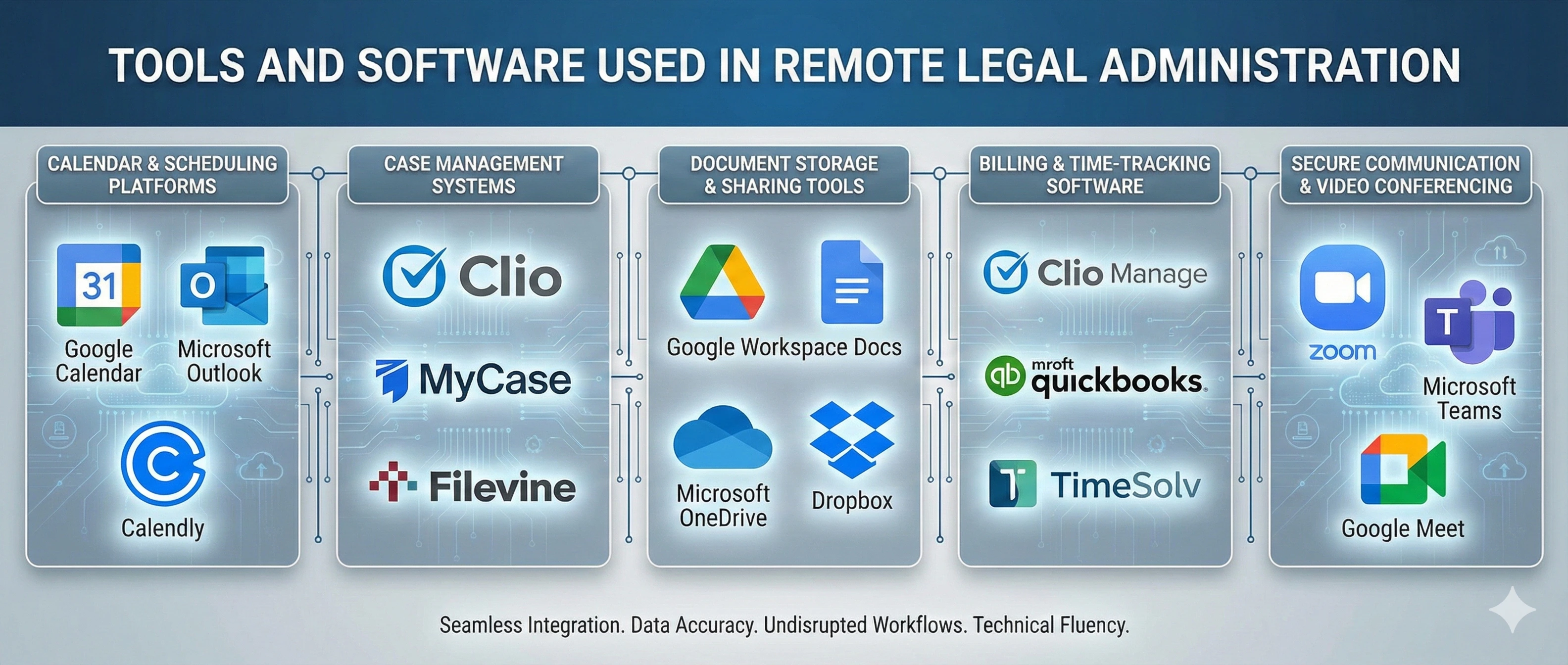
Remote legal administrative assistants are expected to be software-fluent and comfortable working within the digital systems used by U.S. law firms. Legal-trained, U.S. law-experienced assistants typically support attorneys using the following tools:
- Calendar and scheduling platforms
Google Calendar, Microsoft Outlook, Calendly - Case management systems
Clio, MyCase, Filevine - Document storage and sharing tools
Google Workspace (Drive, Docs), Microsoft OneDrive, Dropbox - Billing and time-tracking software
Clio Manage, QuickBooks, TimeSolv - Secure communication and video conferencing platforms
Zoom, Microsoft Teams, Google Meet
This technical fluency allows remote legal administrative assistants to integrate seamlessly into existing firm workflows, maintain data accuracy, and support attorneys without disrupting established systems.
Skills That Matter in Remote Legal Administrative Support
Beyond technical ability, successful legal administrative assistants demonstrate:
- Strong organizational skills
- Attention to detail
- Clear written communication
- Confidential handling of sensitive information
- Time management and accountability
Remote law firms rely on pre-vetted talent pools to ensure assistants meet these standards consistently.
Why Law Firms Choose Pre-Vetted Remote Legal Support
Hiring administrative support independently can be time-consuming and risky. That’s why forward-thinking law firms are increasingly turning to specialized platforms that provide legal-trained, U.S. law-experienced assistants who come pre-screened, pre-vetted, and ready to contribute.
This approach reduces onboarding time, improves reliability, and allows firms to scale support as needed.
Frequently Asked Questions
What does a legal administrative assistant do in a remote law firm?
A legal administrative assistant handles scheduling, communication, document management, billing support, and intake tasks remotely, helping attorneys stay organized and focused on legal work.
Do remote legal administrative assistants need legal training?
Yes. Legal-trained assistants understand legal terminology, workflows, and confidentiality requirements, which allows them to support U.S. law firms accurately and professionally.
How do remote legal administrative assistants protect confidentiality?
They follow strict data security protocols, use secure software, and adhere to confidentiality standards required by law firms handling sensitive legal information.
What software should a remote legal administrative assistant know?
They should be comfortable with case management systems, billing tools, document storage platforms, scheduling software, and secure communication tools used by law firms.
Why do law firms hire pre-vetted legal administrative assistants?
Pre-vetted assistants reduce hiring risk, shorten onboarding time, and provide reliable administrative support aligned with U.S. legal standards.









.webp)




.webp)


%20(1).webp)





















%20(2)%20(2).avif)
.avif)