What Is a Paralegal?
A paralegal is a legal professional who performs substantive legal work under the supervision of an attorney, including legal research, drafting documents, managing case files, and communicating with clients, but cannot provide legal advice or represent clients in court.
The Evolution of Legal Support
If you are researching how to become a paralegal, you are exploring one of the fastest-growing and most strategic roles in the legal industry. The paralegal career path has evolved significantly, moving far beyond traditional clerical and administrative support.
According to the American Bar Association, paralegals assist attorneys with legal research, drafting documents, and case preparation.
Historically, legal assistants focused primarily on administrative tasks such as scheduling and filing. Today, law firms expect paralegals to manage litigation workflows, draft legal documents, coordinate discovery, and support legal strategy.
For law firms, paralegals are no longer overhead. A skilled paralegal increases attorney leverage, reduces operational bottlenecks, and enables firms to scale caseloads without adding attorney headcount. In practical terms, the right paralegal is a revenue-driving asset that directly impacts case throughput, client outcomes, and firm profitability.
Are Paralegal Tasks Billable?
Yes. Many paralegal tasks are billable, particularly legal research, drafting, discovery support, and litigation preparation. This makes paralegals essential to law firm revenue generation and profit margins.
Certified vs. Qualified Paralegals
- Certified paralegal: Completed a certificate program or passed a professional exam
- Qualified paralegal: Has real-world legal experience and demonstrated performance
While certifications signal foundational knowledge, most law firms prioritize experience, drafting competency, and workflow efficiency over credentials alone.
What Is a Litigation Paralegal?
A litigation paralegal supports attorneys during lawsuits by managing discovery, drafting pleadings, organizing evidence, preparing trial materials, and tracking court deadlines.
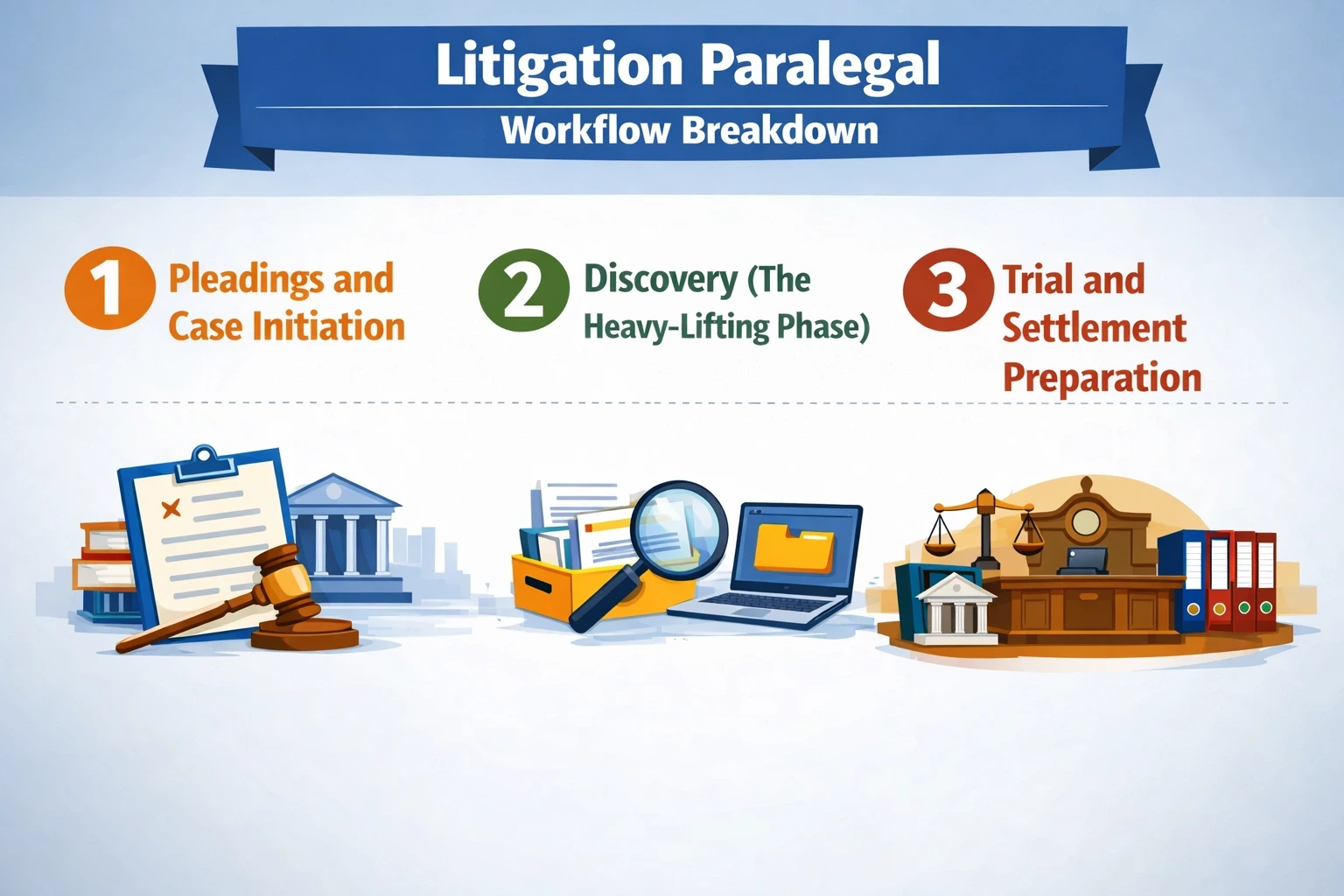
Litigation Paralegal Workflow Breakdown
1) Pleadings and Case Initiation
- Draft complaints, answers, motions, and court filings
- Organize case timelines and litigation calendars
- Track jurisdiction-specific court rules and deadlines
2) Discovery (The Heavy-Lifting Phase)
Litigation paralegals handle large-scale discovery operations, including:
- Reviewing documents for relevance and privilege
- Document indexing, organization, and tracking (including Bates numbering)
- Assisting with privilege logs and discovery tracking
- Summarizing depositions and expert reports
- Supporting e-discovery workflows and large data sets
3) Trial and Settlement Preparation
- Preparing trial notebooks and exhibit binders
- Coordinating witness lists and expert documentation
- Assembling settlement demand packages and mediation materials
Source:
American Bar Association, A Day in the Life of a Litigation Paralegal – https://www.americanbar.org/groups/paralegals/blog/day-in-the-life-of-a-litigation-paralegal/
Why Litigation Paralegals Are Critical for Scaling Law Firms
Litigation paralegals free attorneys from procedural and administrative burdens, allowing them to focus on strategy and courtroom advocacy. A skilled litigation paralegal can double or triple attorney caseload capacity, making them essential for scaling personal injury, workers’ compensation, and commercial litigation practices.
How to Become a Paralegal (Step-by-Step Guide)
- Complete a paralegal certificate, associate degree, or bachelor’s degree
- Gain internship or law firm experience
- Learn legal technology platforms and case management systems
- Develop drafting, discovery, and litigation workflow skills
- Apply to law firms or legal staffing agencies
How Long Does It Take to Become a Paralegal?
- 6–12 months with a certificate program
- 2 years with an associate degree
- 4 years with a bachelor’s degree
- Additional on-the-job training may take 3–12 months
%20-%20visual%20selection.webp)
Paralegal Certificate: ABA-Approved vs Non-Approved
- ABA-approved programs: Strict curriculum standards and faculty requirements
- Non-ABA programs: Often flexible and aligned with real-world workflows
For law firms, experience, legal tech skills, and productivity often matter more than certification status.
Hiring Manager’s Checklist: What Law Firms Should Look for in a Paralegal
- Litigation workflow experience (discovery, pleadings, trial prep)
- Familiarity with Clio, MyCase, Filevine, or similar platforms
- Writing samples and drafting assessments
- Knowledge of court rules, deadlines, and filing procedures
- Client communication and documentation management skills
- Remote collaboration and workflow experience
ROI Calculation: Training vs Managed Remote Services
Training an entry-level paralegal can require 6–12 months of attorney supervision, which is non-billable and costly. Turnover among junior legal staff further increases recruitment and onboarding expenses.
Managed remote services provide experienced paralegals immediately, reducing training costs, operational risk, and payroll overhead. For many firms, outsourcing litigation support delivers a higher ROI, predictable staffing costs, and faster scalability.
The Remote Case Manager Skillset (Modern Paralegal Skills)
To become a paralegal in 2026, professionals must also become legal technologists.
Essential Legal Technology Tools
- Clio: Practice management and billing
- MyCase: Case tracking and client portals
- Filevine: Litigation workflow automation
- Slack / Microsoft Teams: Remote collaboration and communication
Paralegals who master these platforms are significantly more productive and valuable. Legal technology proficiency is now a core hiring requirement.
Read More; https://www.remotecasemanager.com/blogs/top-legal-document-management-tools-remote-case-managers

Build vs Buy: The Strategic Shortcut for Law Firms
Should Law Firms Hire or Outsource Paralegals?
Hiring requires recruitment, training, payroll, benefits, supervision, and office overhead. Outsourcing provides immediate access to experienced paralegals without long-term employment costs.
FAQs
How long does it take to become a paralegal?
It takes 6–12 months with a certificate program or 2–4 years with a degree. Experience significantly affects job readiness.
Do paralegals need certification?
Certification is helpful but not required. Many law firms prioritize experience and legal technology skills over formal credentials.
What is the difference between a legal assistant and a paralegal?
Legal assistants handle administrative tasks, while paralegals perform substantive legal work that may be billable.
What is a litigation paralegal?
A litigation paralegal specializes in supporting lawsuits, including discovery, pleadings, trial preparation, and settlement workflows.
How can law firms scale with paralegals?
Law firms can scale by hiring specialized paralegals or using managed remote services like Remote Case Manager to increase attorney capacity without increasing overhead.









.webp)




.webp)


%20(1).webp)





















%20(2)%20(2).avif)
.avif)