%20(1).webp)
A wrongful termination lawyer represents employees fired in violation of federal or state law including anti-discrimination statutes, retaliation protections, and employment contracts. For law firms managing these cases, legal knowledge is only half the equation. The other half is operational.
Wrongful termination cases are among the most documentation-heavy in employment law. Each case involves multiple claim threads, strict EEOC filing deadlines, and layered evidence requirements from personnel files to electronic communications. Firms that handle high volumes of these cases without dedicated case management support face a consistent bottleneck: administrative work consuming attorney time.
This guide breaks down the key legal elements of wrongful termination representation and explains how firms can build the operational infrastructure needed to handle these cases efficiently and profitably.
Key Takeaways
- Wrongful termination covers multiple claim types discrimination, retaliation, contract breach, and constructive discharge each with different legal thresholds.
- EEOC charges must be filed within 180–300 days of termination. Missing this deadline permanently bars the federal claim.
- Damages can include back pay, front pay, emotional distress, and punitive damages but only if case records are organized and complete.
- High-volume wrongful termination practice requires a dedicated case management layer not just legal talent.
Common Grounds for a Wrongful Termination Claim
Not every unfair firing qualifies as wrongful termination. The legal threshold is whether the dismissal violated a federal statute, state law, employment contract, or public policy.
The Equal Employment Opportunity Commission (EEOC) enforces the primary federal statutes that govern most wrongful termination claims. Here are the most common legal grounds attorneys encounter:
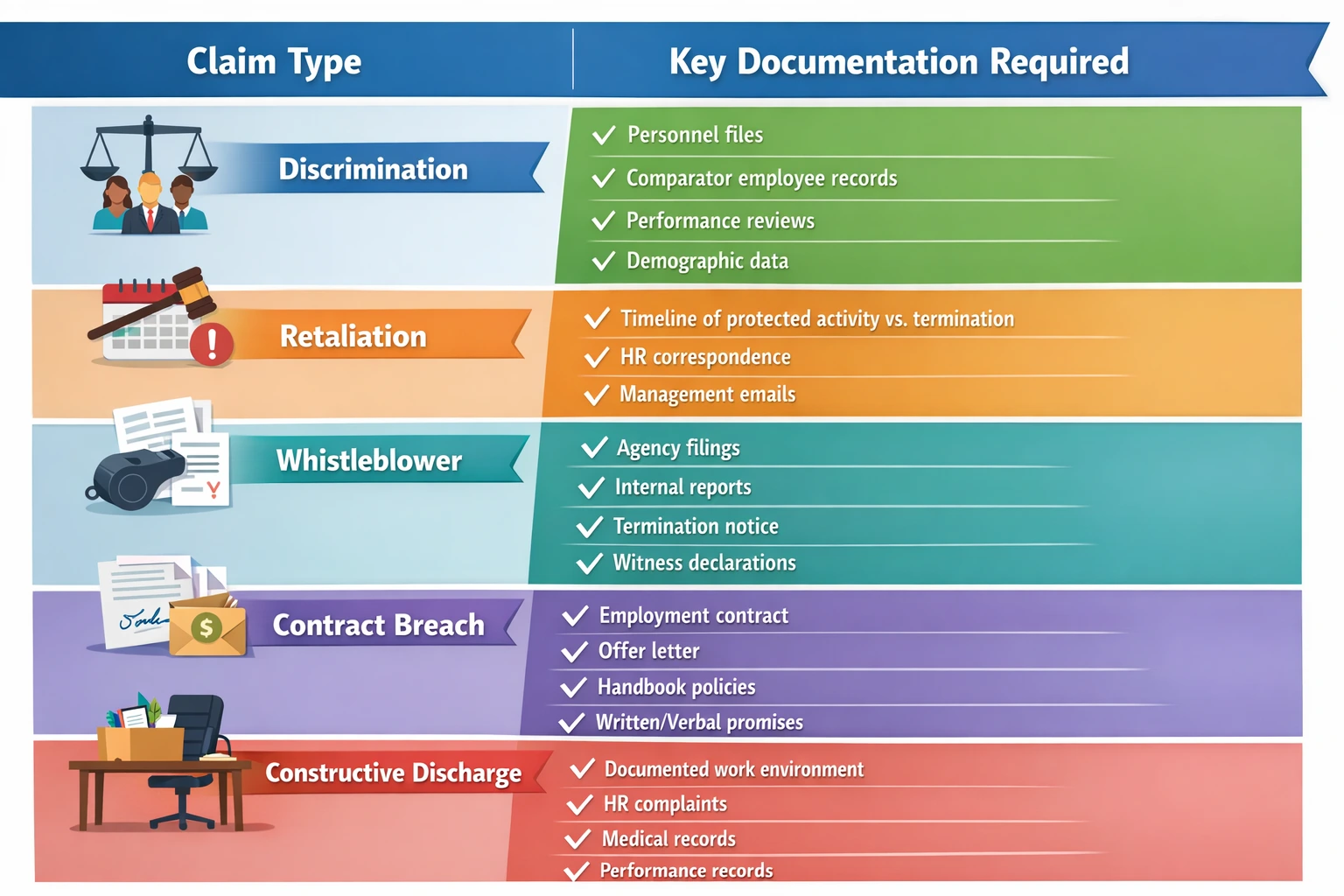
1. Discrimination
Federal law prohibits termination based on race, gender, age, disability, national origin, religion, or pregnancy. Title VII, the ADA, the ADEA, and the Pregnancy Discrimination Act each cover a specific protected class.
- Cases require proof of protected class status, adverse employment action, and employer pretext.
- Comparative evidence showing how similarly situated employees outside the protected class were treated is often decisive.
2. Retaliation
Retaliation is one of the most actionable wrongful termination theories. Employees are protected from termination for:
- Filing an EEOC charge or participating in a discrimination investigation
- Reporting workplace harassment or unsafe conditions
- Requesting FMLA leave or filing a workers' compensation claim
- Complaining internally about wage violations or discriminatory treatment
3. Whistleblower Violations
Federal and state whistleblower statutes protect employees who expose illegal activity, financial fraud, or regulatory violations.
The U.S. Department of Labor's whistleblower protection programs cover more than 20 federal statutes across industries including finance, healthcare, and workplace safety.
4. Breach of Employment Contract
When a written contract or an implied contract (employee handbook, verbal promise of job security) exists, a termination without good cause may constitute breach of contract — even in at-will states.
5. Constructive Discharge
When an employer makes working conditions deliberately intolerable through harassment, demotion, or denial of equal opportunity to force a resignation, courts treat the outcome as termination. Proving this claim requires detailed documentation of the workplace environment over time.
6. Public Policy Exception
Most states protect employees fired for exercising a legal right filing a workers' compensation claim, serving on jury duty, or refusing to engage in illegal conduct. The strength of this claim varies significantly by state.
What a Wrongful Termination Lawyer Does in Litigation
For law firm owners and managers, understanding the full scope of representation clarifies where case administration bottlenecks form and where support staff add the most leverage.
Case Intake and Merit Assessment
Attorneys begin by determining whether the claim meets the legal threshold for action. The three factors that most affect case strength are:
- Timing — How close was the termination to a protected activity?
- Documentation — Do performance records contradict the employer's stated reason?
- Motive — Is there evidence of bias or inconsistent policy application?
High-volume intake requires a structured triage process. Without it, attorneys spend disproportionate time screening cases that won't convert into viable litigation.
EEOC Charge Filing and Agency Management
Federal discrimination and retaliation claims cannot go to court without an EEOC charge on file first. Filing correctly with accurate dates, claim categories, and factual narratives directly affects the scope of any subsequent lawsuit.
- Filing and preparing the charge of discrimination
- Responding to EEOC information requests
- Attending agency mediation sessions
- Tracking Right to Sue notice deadlines after issuance
Discovery and Evidence Development
This phase generates the heaviest case administration workload. Attorneys must:
- Depose supervisors and HR personnel to uncover true termination motives
- Subpoena electronic records, internal memos, and personnel files
- Gather and organize medical records in FMLA or ADA-related claims
- Coordinate witness interviews and declarations
In multi-claim cases, this can involve hundreds of hours of document management before a single motion is filed.
Settlement Negotiation and Litigation
Most wrongful termination cases settle before trial. Attorneys calculate and document all compensable damages to build a strong demand package. When settlement is not reached, the case proceeds to pleadings, hearings, and trial each phase requiring precise case file organization.
Potential Compensation in Wrongful Termination Cases
Recoverable damages vary by claim type, jurisdiction, and the strength of the documentation. Understanding what is compensable and what records are needed to prove it is critical for maximizing recovery.
- Back Pay: Lost wages and benefits from the date of termination through verdict or settlement. Requires salary history, pay stubs, bonus records, and benefits documentation.
- Front Pay: Future lost earnings when reinstatement is impractical. Often calculated with expert economic testimony based on career trajectory and labor market data.
- Reinstatement: Less common in practice. More useful as a negotiating position or where the client has a specific interest in returning to their prior role.
- Emotional Distress Damages: Compensation for psychological harm. Substantiated through medical records, therapist notes, and client declarations.
- Punitive Damages: Available in federal discrimination cases involving malice or reckless indifference. Federal caps apply: $50,000–$300,000 depending on employer size under Title VII.
- Attorney Fees and Costs: Under Title VII and several other federal statutes, prevailing plaintiffs may recover attorney fees making these cases financially viable on contingency.
Precise damage documentation is what separates maximum recoveries from undersettled cases. Every category above depends on accurate, organized case records.
Statute of Limitations: Deadlines That Govern Every Wrongful Termination Case
Missed deadlines are permanent. No amount of legal merit can revive a claim filed after the statute of limitations has expired. For employment law firms managing multiple active cases, deadline tracking is one of the highest-stakes operational functions.
For federal claim deadlines, EEOC's official guidance on time limits for filing a charge is the authoritative source.
Steps to Find a Qualified Wrongful Termination Lawyer
For employees evaluating representation and for firm owners building out their employment law practice the following criteria define what a qualified wrongful termination attorney looks like.
- Verify employment law specialization. General practitioners and PI attorneys don't have the procedural knowledge required for EEOC filings, federal discrimination claims, or Title VII litigation.
- Review their case history. Ask specifically about EEOC outcomes, federal verdicts, and settlement results in discrimination and retaliation cases.
- Confirm contingency fee structure. Most employment attorneys handle these cases on contingency, meaning no upfront cost to the client. Firms should clarify the percentage and cost-recovery terms.
- Assess case management protocols. Ask how the firm handles document intake, deadline tracking, and client communication. Poor administration is the leading cause of missed filings, not lack of legal skill.
- Confirm HIPAA-compliant data handling. Cases involving FMLA, ADA, and workers' compensation retaliation frequently involve protected health information. Remote or hybrid support staff must operate under compliant protocols.
How Dedicated Case Management Support Improves Wrongful Termination Practice
Employment law firms scaling their wrongful termination practice consistently face the same operational constraints: intake volume outpaces attorney bandwidth, documentation management consumes paralegal time, and EEOC deadline tracking becomes a high-stakes manual process.
Remote case managers trained in employment law workflows integrate directly into a firm's operations to handle the administrative layer without adding full-time overhead.
What a Remote Case Manager Handles in Wrongful Termination Cases
- Client intake interviews and case file organization
- Evidence collection personnel files, performance records, medical documentation
- EEOC deadline tracking and charge preparation support
- Demand letter drafting and settlement statement preparation
- Deposition scheduling and discovery coordination
- Client communication and case status updates
Law firms using dedicated employment law case management support through Remote Case Manager report 90% efficiency improvements and over $55,000 in average annual savings. More than 1,000 law firms have integrated pre-vetted, full-time remote case managers into their workflows operating under attorney supervision as dedicated team members.
Firms managing workers' compensation retaliation claims alongside wrongful termination cases can extend the same remote case management model to workers' comp workflows creating a unified operational layer across both practice areas.
For firm managers evaluating capacity, the key question is not whether to hire support staff it's whether in-house hiring or a pre-vetted remote model better fits the firm's caseload and overhead structure.
See how firms are restructuring around remote staffing in How Remote Staffing Transforms Law Firms.
For firms managing post-settlement documentation, Are Personal Injury Settlements Taxable? covers how case managers support accurate disbursement and records management after resolution.
Operational Infrastructure Is the Real Edge in Wrongful Termination Litigation
Winning wrongful termination cases requires legal expertise. Building a practice that handles them profitably at scale requires something else: an operational foundation that can manage intake volume, maintain strict deadline compliance, and produce the organized documentation that drives maximum recovery.
The firms that consistently outperform in this practice area are not necessarily the ones with the best attorneys. They are the ones with the best systems combining skilled legal representation with a dedicated administrative layer that keeps every case moving from intake to resolution.
Whether your firm is adding wrongful termination to an existing employment law practice or scaling an established caseload, the operational infrastructure matters as much as the legal strategy.
FAQ
What qualifies as wrongful termination?
Wrongful termination occurs when an employer fires someone due to discrimination, retaliation, contract breach, or a violation of public policy or federal law.
How long do I have to file a wrongful termination claim?
File an EEOC charge within 180–300 days of termination. After a Right to Sue notice is issued, you have just 90 days to file a federal lawsuit.
How much can you get from a wrongful termination lawsuit?
Settlements typically range from $5,000 to $80,000+, covering back pay, emotional distress, and punitive damages, depending on case facts and jurisdiction.
Do I need a lawyer for a wrongful termination claim?
Yes. Claimants with attorneys are twice as likely to win and receive an average settlement of $48,800 — more than double those who file without legal help.
How much does a wrongful termination lawyer cost?
Most wrongful termination lawyers work on contingency, meaning no upfront cost. They typically collect 30–35% of the settlement only if you win your case.









.webp)




.webp)
























%20(2)%20(2).avif)
.avif)