A litigation paralegal is a legal professional who manages the procedural and documentary workload of lawsuits, from the initial complaint through trial and appeal, working directly under attorney supervision. Unlike general paralegals who may rotate across practice areas, litigation paralegals are trained specifically for the adversarial, deadline-driven demands of court proceedings.
For law firm owners and managers, understanding this role clearly affects hiring decisions, caseload capacity, and how well attorneys can focus on strategy instead of paperwork.
Key Takeaways
- Litigation paralegals handle the full lifecycle of a civil case, including drafting, discovery, trial prep, and courtroom support.
- The role is distinct from a general paralegal. Firms with active litigation dockets need someone trained for this specific environment.
- A strong paralegal job description filters for litigation-specific experience, not just general legal background.
- Remote and outsourced litigation paralegal support is a growing alternative to the traditional in-house hire, particularly for firms managing fluctuating caseloads.
What Does a Litigation Paralegal Do?
Litigation paralegals own the case workflow that attorneys cannot afford to manage themselves. They handle the bulk of substantive legal work that keeps a case moving, organized, and compliant with court deadlines.
Here is a breakdown of their core responsibilities:
- Drafting Pleadings and Motions
Litigation paralegals produce the first drafts of critical court documents. Attorneys review and approve; paralegals build, organize, and finalize.
Common documents they draft include:
- Complaints and Answers — the opening documents that initiate and respond to a lawsuit
- Motion to Dismiss — requests the court to dismiss the case on procedural grounds
- Motion to Compel — forces a party to comply with discovery requests
- Motion for Summary Judgment — asks the court to decide a case without a full trial
- Motion in Limine — seeks to exclude specific evidence before trial
This is substantive legal work. A paralegal who cannot draft clearly and precisely slows down the entire case.
- Managing the Discovery Phase
Discovery is typically the most time-intensive part of civil litigation. It is where both sides exchange evidence before trial.
A litigation paralegal's discovery duties include:
- Drafting interrogatories (written questions sent to the opposing party)
- Drafting requests for production of documents
- Preparing deposition notices and deposition binders
- Responding to opposing counsel's discovery requests
- Managing electronically stored information (ESI) using e-discovery platforms like Relativity or Clio
- Organizing evidence into summary charts and binders for attorney review
According to the Bureau of Labor Statistics, law firms remain the largest employer of paralegals precisely because this volume of work cannot fall on attorneys alone.
- Trial Preparation and Courtroom Support
As a case moves toward trial, the litigation paralegal shifts into a logistics and coordination role.
Trial prep tasks include:
- Building trial notebooks with exhibit lists, witness schedules, and opening statement materials
- Preparing hearing binders for arbitrations and mediations
- Coordinating witness availability
- Managing courtroom technology during trial
- Locating exhibits in real time as the attorney examines witnesses
- Taking notes on testimony and tracking evidence
The paralegal is effectively the attorney's operational support system during trial. When this role is filled poorly, attorneys lose focus and cases fall apart organizationally.
- Case Communication and Deadline Management
Litigation paralegals serve as the primary point of contact between attorneys, clients, opposing counsel, court personnel, and outside vendors. They track all court-imposed deadlines and handle electronic filings through systems like PACER and state-level e-filing platforms.
Missing a filing deadline in civil litigation can result in sanctions, case dismissal, or serious malpractice exposure. This is not a role that tolerates disorganization.
Civil litigation covers a wide range of dispute types: personal injury, employment law, intellectual property, insurance defense, contract disputes, medical malpractice, and more. A litigation paralegal can often move between these specialty areas with a short learning curve, since the core litigation process is consistent. But placing a transactional paralegal on an active litigation docket is a common and costly mistake.
For a deeper look at how civil and commercial litigation differ, see our guide on commercial litigation vs. civil litigation.
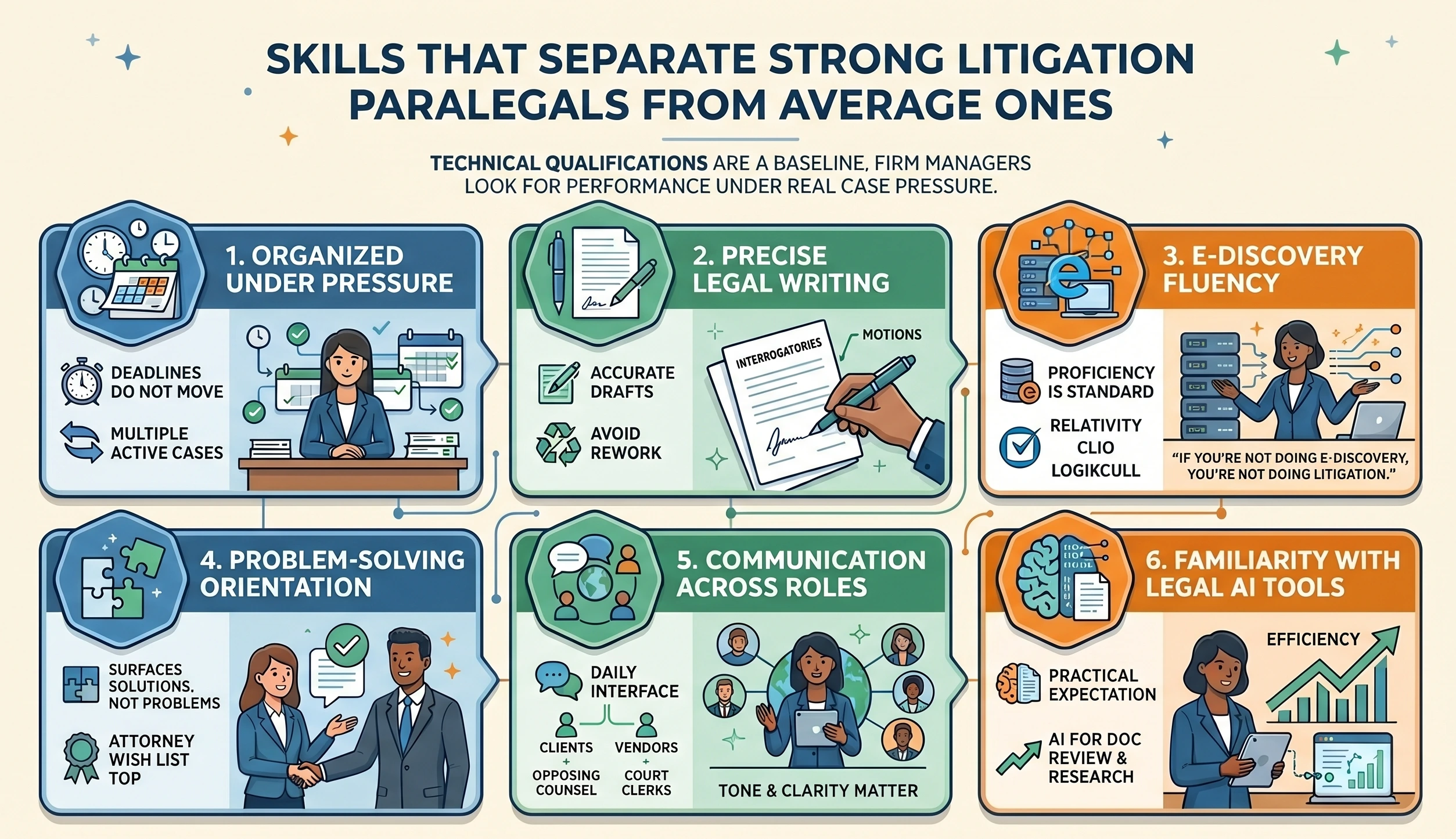
Skills That Separate Strong Litigation Paralegals from Average Ones
Technical qualifications are a baseline. What law firm managers actually need to evaluate is how a paralegal performs under real case pressure.
1. Organized under pressure Court calendars do not move. A strong litigation paralegal tracks overlapping deadlines across multiple active cases without letting anything slip, even when the workload spikes.
2. Precise legal writing Drafting interrogatories, discovery responses, and motions requires accuracy. Sloppy drafts create rework for attorneys and delay filings.
3. e-Discovery fluency Proficiency with platforms like Relativity, Clio, or Logikcull is increasingly standard. As one experienced litigation professional put it: if you're not doing e-discovery, you're not doing litigation.
4. Problem-solving orientation Attorneys consistently rank this at the top of their wish list. A paralegal who surfaces solutions, not just problems, becomes genuinely indispensable to the team.
5. Communication across roles Litigation paralegals interface daily with clients, opposing counsel, vendors, and court clerks. Tone and clarity matter in every channel.
6. Familiarity with legal AI tools This is becoming a practical expectation. Paralegals using AI for document review and research drafts are contributing meaningfully to firm efficiency, and the gap between those who do and those who don't is widening.
What to Include in a Litigation Paralegal Job Description
A weak paralegal job description attracts the wrong candidates and extends your search. Here is what a strong one covers.
Minimum Qualifications
- Associate's or bachelor's degree in paralegal studies
- Paralegal certificate from an ABA-approved program
- 2 to 5 years of direct litigation experience, depending on seniority
- Familiarity with e-discovery platforms and electronic court filing systems
Core Responsibilities to List
Be specific. Vague job descriptions produce vague applicants.
- Drafting and filing motions, pleadings, and discovery documents
- Managing discovery from initiation through production
- Preparing trial notebooks, exhibit lists, and deposition binders
- Maintaining case calendars and court filing deadlines
- Communicating with clients, opposing counsel, and court personnel
Salary Benchmarks
The median annual wage for paralegals and legal assistants was $61,010 in May 2024, according to the Bureau of Labor Statistics. U.S. Bureau of Labor Statistics Litigation paralegals in active court practices typically earn above that median. Senior litigation paralegals in major metro markets with 10 or more years of experience commonly earn between $85,000 and $170,000, depending on firm size, specialty, and geography.
e-Discovery specialists command a premium across the board. If you are hiring for a high-volume discovery practice, budget accordingly.
Common Hiring Mistakes to Avoid
- Listing too many "preferred" qualifications that bury the actual requirements
- Confusing legal assistant with litigation paralegal in the posting. These are different roles with different scopes and different pay expectations
- Skipping the ethics clause — your job description should note that paralegals cannot give legal advice or represent clients in court. This protects the firm and sets expectations from day one
For firms evaluating their full legal staffing approach, this job description framework applies whether you are hiring in-house or through a staffing partner.
How Law Firms Are Solving the Litigation Paralegal Staffing Problem
Finding a qualified litigation paralegal is harder than it was five years ago. The job market for paralegals has remained stable even during economic downturns, which means competition for skilled candidates is ongoing.
Firms in smaller markets face limited local talent. Metro firms deal with higher salary expectations. And high-volume litigation practices often need experienced support faster than a full hiring cycle allows.
Despite limited employment growth, about 39,300 openings for paralegals and legal assistants are projected each year, with most resulting from the need to replace workers who exit the labor force. U.S. Bureau of Labor Statistics That turnover keeps the hiring pressure consistent for law firms year over year.
More firms are turning to remote litigation paralegal support as either a bridge or a permanent solution. Remote case managers who specialize in litigation workflows can integrate directly into your case management system, handle discovery coordination, draft documents, and keep cases on deadline without the overhead of a full-time in-house hire.
If your firm is managing active caseloads with a short-staffed team, Remote Case Manager connects you with pre-vetted legal professionals who are ready to start fast. See our services or view pricing to see what that looks like for your practice.
Frequently Asked Questions
How much do litigation paralegals make in the US? The BLS reports a median of $61,010 annually as of May 2024. Litigation paralegals in metro markets with senior experience commonly earn $85,000 to $170,000.
What is the difference between a paralegal and a litigation paralegal? A general paralegal works across practice areas. A litigation paralegal focuses on court proceedings, including drafting motions, managing discovery, and trial preparation, with stricter deadlines and higher stakes.
What is the highest paid type of paralegal? e-Discovery specialists and those in complex commercial litigation, IP, or securities law earn the most. Senior specialists at large firms regularly exceed $100,000 annually.
Is being a litigation paralegal hard? Yes. Deadlines are fixed, caseloads are heavy, and the margin for error is small. Long hours are common near trial. Firms that want to retain good litigation paralegals need to offer more than salary alone.
Do you need a degree to be a litigation paralegal? Most firms require an associate's or bachelor's degree in paralegal studies plus an ABA-approved certificate. Verify ABA approval before making any hiring decision based on a candidate's certificate program.
Is a Litigation Paralegal the Right Fit for Your Firm's Needs?
A litigation paralegal is the operational backbone of a functioning case. The right person, whether in-house or remote, keeps attorneys focused on legal strategy while everything else stays on track.
If your firm handles employment law, personal injury, insurance defense, or any other civil litigation practice, the quality of your paralegal support directly affects case outcomes, client satisfaction, and attorney capacity.
Firms that staff this role well move faster, take on more cases, and lose fewer cases to administrative breakdowns. Those that leave the seat empty or fill it with the wrong candidate pay for it in missed deadlines, billing gaps, and attorney burnout. For more on building a high-performing support team, read our post on law firm staffing strategy and retaining paralegals in 2026 and legal assistant vs. paralegal: key differences explained.
Ready to see how remote litigation support works in practice? Book a free consultation and browse our network of pre-vetted legal professionals.









.webp)



.webp)


%20(1).webp)






















%20(2)%20(2).avif)
.avif)