Key Takeaways
- Law firms save up to 70% on staffing costs by hiring full-time remote case managers instead of in-house paralegals.
- The BLS reports roughly 39,300 paralegal openings annually through 2034, driven by turnover rather than new positions.
- Pre-vetted remote case managers integrate into U.S. legal workflows within days, handling intake, medical records, and demand letters.
- Month-to-month billing with no long-term contracts gives firms flexibility to scale alongside caseload demands.
- Remote case managers work alongside licensed attorneys to ensure compliance while reducing administrative burden.
The legal staffing landscape is shifting. Rising overhead, talent shortages, and increasing caseloads are pushing law firms to rethink how they fill paralegal-level roles. Remote paralegal jobs are no longer a pandemic-era workaround. They represent a structural change in how legal support gets delivered.
According to the U.S. Bureau of Labor Statistics, there are roughly 376,200 paralegals employed nationwide, with about 39,300 openings projected annually through 2034. Most come from turnover, not expansion. For firms competing for experienced talent, the hiring pool is tight.
At the same time, attorneys spend only 38% of their workday on billable tasks. The rest goes to administrative work that trained support staff could handle. This is where remote case managers come in: pre-vetted, trained, experienced professionals who handle paralegal-level tasks full-time, billed monthly on a month-to-month basis.
What Are Remote Paralegal Jobs and Why Are They Growing?
Understanding what paralegal remote jobs look like from the employer side is essential before making a hiring decision. The scope of work and the talent market have both shifted.
The Scope of Remote Paralegal-Level Work
Remote paralegal jobs cover a wide range of tasks that support licensed attorneys. When performed by dedicated remote case managers, these responsibilities include:
- Client intake and initial case screening
- Medical record retrieval and organization
- Demand letter drafting and insurance claim follow-up
- Discovery coordination and document review
- Settlement tracking and case file management
- Court deadline monitoring and calendar management
These are not freelancers splitting time across multiple firms. Remote case managers work full-time and are dedicated exclusively to your practice. They support licensed attorneys by handling the operational workload that slows down case progression.
Why Demand Is Increasing in 2026
Robert Half’s 2026 research reports that 72% of legal leaders plan to increase headcount in the first half of the year, with 71% also looking to hire contract or temporary professionals. Paralegal unemployment sits at just 2.0%, well below the national average. Firms that rely solely on local hiring are competing in an increasingly shallow talent pool.
At the same time, law firms are handling more specialized caseloads across personal injury, immigration, and employment law. Finding local candidates with practice-area experience adds another layer of difficulty. Remote staffing removes geographic limitations and gives firms access to trained professionals regardless of location.
In-House Paralegal vs. Remote Case Manager: A Cost and Efficiency Comparison
For most law firm owners, the decision comes down to numbers. Here is how the two models compare on cost, onboarding, and flexibility.
What You Actually Pay
The median paralegal salary in the United States is $61,010 per year. Once you add benefits, office space, equipment, and HR overhead, total cost per employee can exceed $85,000 annually. Remote case managers eliminate the majority of these hidden costs.
Operational Advantages Beyond Cost
Cost savings matter, but operational efficiency is where remote case managers deliver compounding value:
- Faster onboarding. Pre-vetted professionals trained in U.S. legal workflows integrate within days, not months.
- Dedicated support. Each remote case manager works exclusively for your firm, building deep case knowledge over time.
- No commitment risk. Month-to-month billing means you scale up or down based on caseload without long-term obligations.
- Compliance focus. Remote case managers work alongside licensed attorneys, ensuring compliance with contracts and business agreements while maintaining high standards.
Clio’s 2025 Legal Trends Report found that the average law firm utilization rate is just 38%. Every hour an attorney spends on intake or medical record follow-ups is an hour not spent on billable work. Delegating these tasks directly impacts revenue.
How to Hire Remote Case Managers for Paralegal-Level Work
Knowing you need remote support is one thing. Hiring the right person efficiently is another. Here is the step-by-step process that works for most law firms.
Step 1: Define Your Caseload Needs
Start by identifying which tasks consume the most attorney time. Common areas include client intake, medical record retrieval, demand letter drafting, and insurance follow-up. Clarify whether you need practice-area-specific support or general case management across your firm.
Step 2: Set Your Hiring Criteria
Not all remote legal support is equal. When evaluating candidates for paralegal remote jobs, prioritize:
- Experience with U.S. legal workflows, court systems, and compliance standards
- Proficiency in practice management software (Clio, MyCase, Smokeball, PracticePanther)
- Demonstrated case management skills: intake, medical records, demand letters, settlement coordination
- Strong written and verbal English communication
- Full-time availability dedicated to your firm, not split across multiple clients
Step 3: Choose Between DIY Hiring or a Staffing Partner
Hiring independently means screening overseas candidates without standardized vetting. Training from scratch on U.S. legal procedures takes months, and managing cross-border payroll adds administrative burden that defeats the purpose of outsourcing.
A staffing partner like Remote Case Manager removes these barriers. Every professional is pre-vetted, trained, and experienced across personal injury, immigration, workers compensation, employment, and family law. Firms get full-time, dedicated support billed monthly with no long-term contracts.
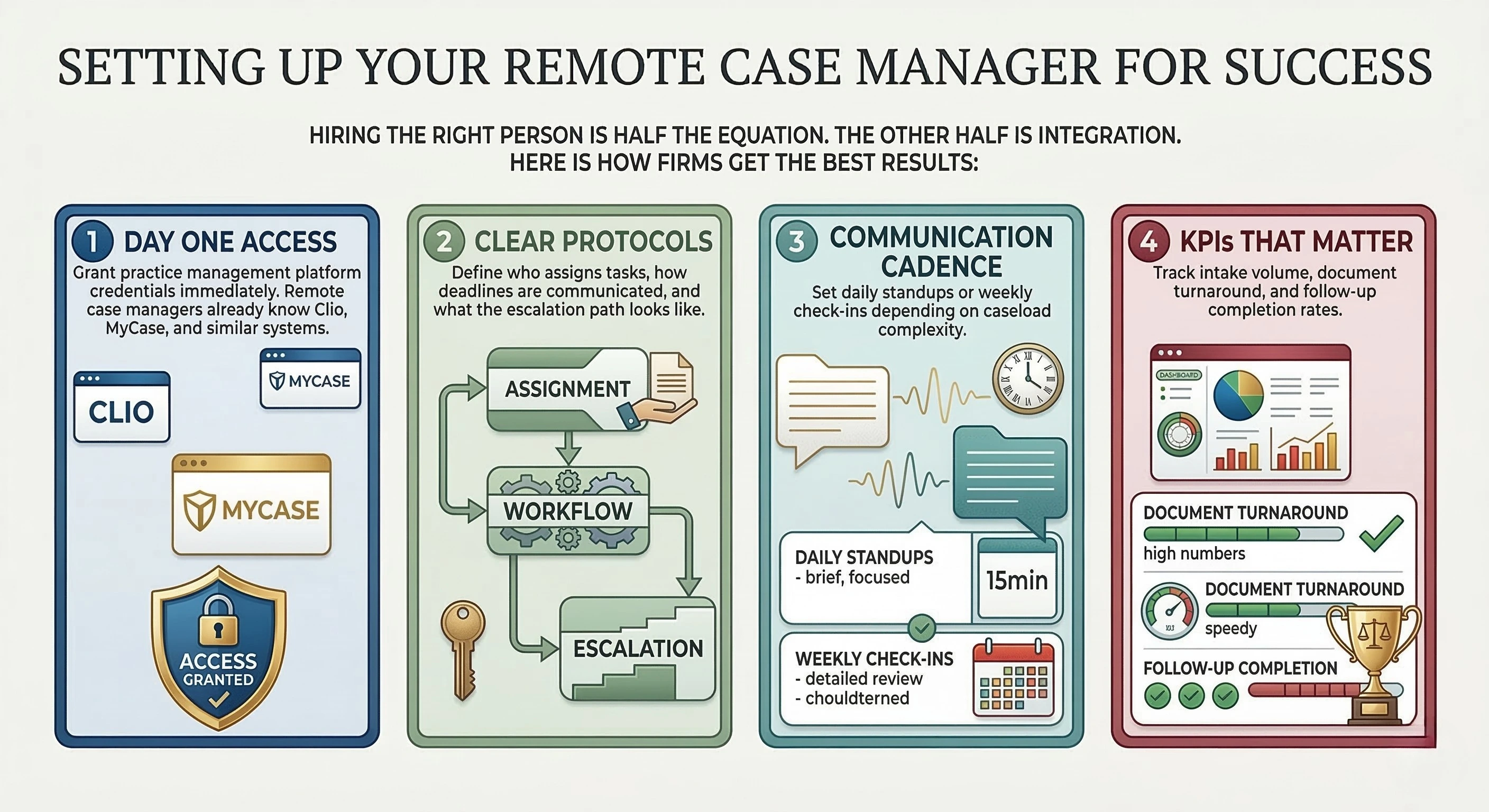
Setting Up Your Remote Case Manager for Success
Hiring the right person is half the equation. The other half is integration. Here is how firms get the best results:
- Day one access. Grant practice management platform credentials immediately. Remote case managers already know Clio, MyCase, and similar systems.
- Clear protocols. Define who assigns tasks, how deadlines are communicated, and what the escalation path looks like.
- Communication cadence. Set daily standups or weekly check-ins depending on caseload complexity.
- KPIs that matter. Track intake volume, document turnaround, and follow-up completion rates.
For a detailed breakdown of recommended platforms, see our guide on the top tools and software for managing remote case managers in law firms.
Common Concerns About Remote Paralegal Jobs (and How to Address Them)
“How do I know the quality will match in-house staff?”
Pre-vetted remote case managers come with 2–3+ years of experience and are already trained in U.S. legal workflows. They are not entry-level hires learning on your dime.
“What about compliance and data security?”
Remote Case Manager provides HIPAA-compliant remote case managers with secure documentation protocols that meet industry standards.
“Am I locked into a long contract?”
No. Billing is month-to-month. Scale up during heavy caseload periods or adjust as needed. There are no long-term contracts.
“Will they understand my specific practice area?”
Remote Case Manager staffs across personal injury, immigration, workers comp, employment, and family law. Professionals are matched based on practice area experience.
Why Forward-Thinking Law Firms Are Filling Paralegal Roles Remotely in 2026
The firms gaining a competitive edge in 2026 are not just adopting technology. They are rethinking how legal support gets staffed. Remote paralegal jobs have evolved from a temporary workaround into a proven staffing model that delivers cost savings, efficiency, and access to trained talent.
The key is choosing the right model. Dedicated, pre-vetted, full-time remote case managers outperform freelancers because they build institutional knowledge about your cases, clients, and workflows.
Frequently Asked Questions
Is there demand for remote paralegals?
Yes. The BLS projects 39,300 annual paralegal openings through 2034, and Robert Half reports 72% of legal leaders plan to increase headcount in 2026.
How much can a law firm save by hiring a remote case manager?
Firms save up to 70% annually. A remote case manager starts at $2,525/month compared to $85,000+ for an in-house paralegal with benefits.
What tasks can a remote case manager handle?
Client intake, medical records retrieval, demand letters, insurance follow-up, discovery support, settlement tracking, and calendar management.
Do remote case managers work with specific practice management software?
Yes. They are trained on Clio, MyCase, Smokeball, PracticePanther, and other major legal platforms used by U.S. law firms.
Can I hire a remote case manager without a long-term contract?
Absolutely. Remote Case Manager offers month-to-month billing with no long-term commitments. Scale up or down based on your caseload needs.









.webp)




.webp)


%20(1).webp)





















%20(2)%20(2).avif)
.avif)