
Key Takeaways
- Law firm growth depends on both lead generation and a fast, structured intake system.
- Digital channels like SEO, websites, and local search deliver the highest and most consistent ROI.
- Responding within 5 minutes can increase conversion rates by up to 400%.
- Referrals, thought leadership, and client retention remain underutilized but high-impact growth drivers.
- Marketing and operations must work together — otherwise, valuable leads and budget are lost.
Most law firms don’t struggle with legal expertise — they struggle with consistent client acquisition.
Today’s legal clients search online, compare multiple firms, and choose based on two things:
- Trust signals (reviews, website, authority)
- Speed of response

In fact, firms that respond quickly are far more likely to convert leads. According to Harvard Business Review, responding within one hour makes companies 7× more likely to qualify a lead.
This reveals a critical gap in most law firm marketing strategies:
Marketing generates the lead — but systems convert it into a client.
Without fast intake, structured follow-up, and consistent communication, even the best marketing campaigns fail.
This guide breaks down 20 proven law firm marketing strategies — organized into systems that drive visibility, trust, and signed clients.
What Is Law Firm Marketing — and Why Most Firms Get It Wrong
Law firm marketing is the full set of activities a firm uses to attract, convert, and retain legal clients. It includes brand building, digital visibility, referral development, client intake, and reputation management.
Most firms treat marketing as a reactive expense—scaling it up when cases are low and cutting it when busy. This creates inconsistent growth and weak long-term results.
Legal marketing operates as a funnel with four stages:
- Awareness — prospects discover your firm (SEO, ads, referrals)
- Consideration — they evaluate you (website, reviews, content)
- Intake — they reach out and experience your response process
- Retention — they hire you, refer others, and return

The biggest breakdown happens at the intake stage—where interest turns into action.
Research shows that 67% of legal clients choose the firm that responds first, and firms that respond within five minutes can increase conversion rates by up to 400%.
This is where most marketing efforts fail—not from lack of leads, but from slow response, missed follow-ups, and unstructured intake systems.
Speed at intake is not just an operations issue. It is a marketing problem with an operational solution.
Build Your Foundation First
Before spending on ads or content, your foundation must be solid. These four strategies determine whether everything else works
1. Define Your Niche and Ideal Client Profile
Undifferentiated firms compete on price. Niche firms compete on authority. The first law firm marketing strategy for growth is knowing exactly who you serve, where, and why you are the best option for them.
- Choose your primary practice area(s) and geographic focus
- Define your ideal client by situation, not just demographics
- Write a one-sentence positioning statement: "We help [client type] with [specific problem] in [location]."
2. Build a Consistent Law Firm Brand
Your brand is every signal of trust you send before a prospect calls. Visual identity, tone of voice, and messaging must be consistent across your website, social profiles, intake communications, and even voicemail.
Inconsistent branding reduces perceived credibility — even if your legal work is excellent.
3. Create a High-Converting Law Firm Website
65% of law firms say their website delivers the highest marketing ROI of any channel. Yet most law firm websites bury the consultation call-to-action, load slowly on mobile, and use generic copy.
Your website must include:
- Mobile-first design with fast load speed (under 3 seconds)
- A clear headline that states who you help and how
- Dedicated practice area pages — one per service
- Attorney bio pages with credentials and bar memberships
- Social proof: client testimonials, case results (where allowed), awards
- A prominent consultation CTA above the fold on every page
4. Optimize Your Google Business Profile for Local Search
For solo and small firms, local search is the single highest-ROI digital channel. Google’s local results prioritize relevance, distance, and prominence, making a well-optimized Google Business Profile critical for visibility and client acquisition.
- Claim and fully complete your Google Business Profile
- Ensure NAP consistency (Name, Address, Phone) across every listing
- Add practice area tags, business hours, photos, and FAQs
- Actively collect Google reviews — more on this in Strategy 12
This is the entry point for law firm marketing strategies for growth areas at the local level — and it costs nothing but time.
Get Found Online — Digital Marketing Strategies
With your foundation in place, these six strategies build the digital visibility that brings prospects to your door — organically and through paid channels.
5. Invest in Organic SEO for Law Firms
SEO is the most durable law firm marketing strategy for growth. The three-year ROI on law firm SEO averages 526% — the highest of any digital channel. The catch: it takes time to compound.
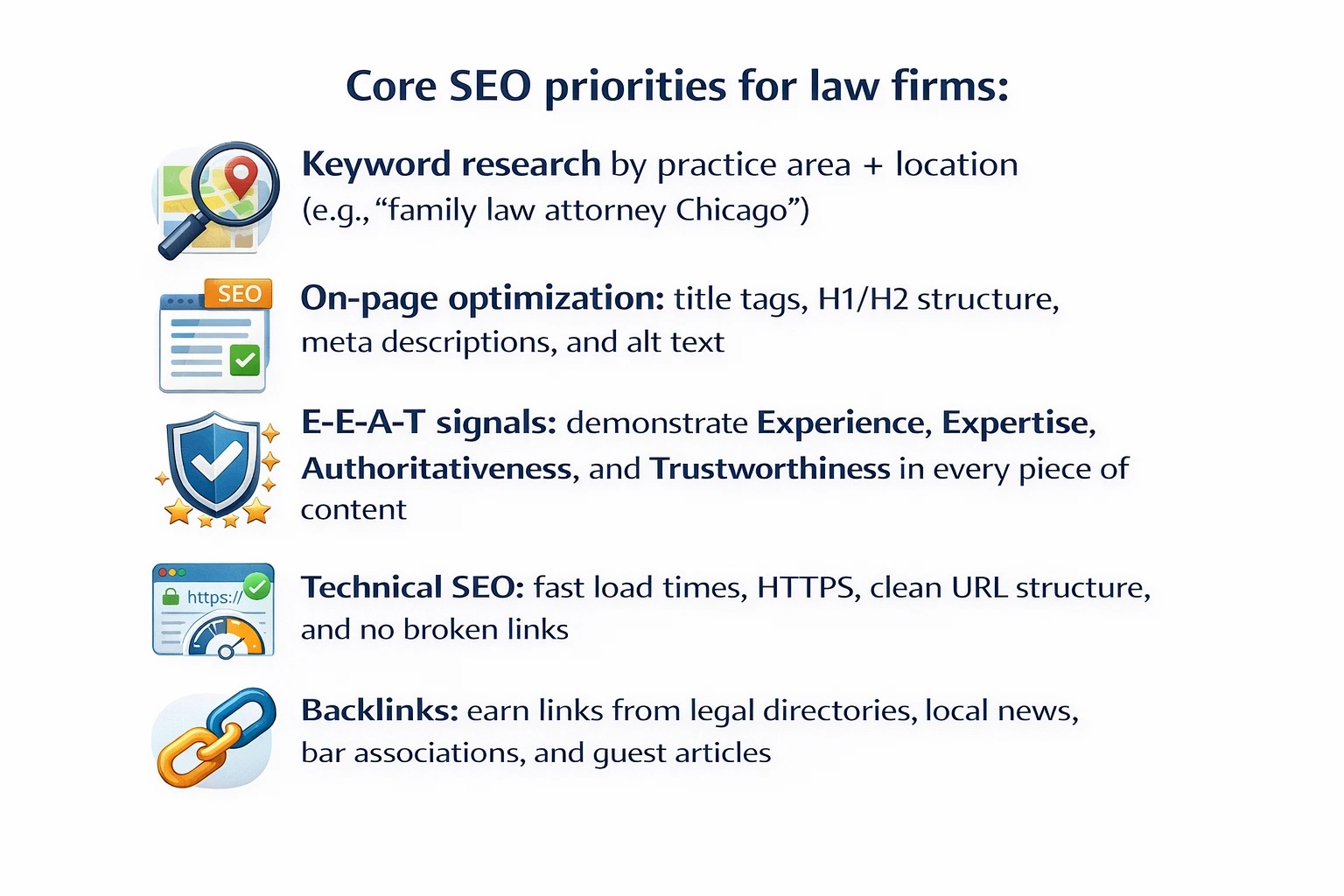
Core SEO priorities for law firms:
- Keyword research by practice area + location (e.g., "family law attorney Chicago")
- On-page optimization: title tags, H1/H2 structure, meta descriptions, and alt text
- E-E-A-T signals: demonstrate Experience, Expertise, Authoritativeness, and Trustworthiness in every piece of content
- Technical SEO: fast load times, HTTPS, clean URL structure, and no broken links
- Backlinks: earn links from legal directories, local news, bar associations, and guest articles
6. Publish Answer-First Legal Blog Content
Law firm blogs generate qualified leads when they focus on answering real client questions—not writing for other lawyers.
Topics like “What happens if I miss a workers’ comp deadline?” or “Do I need a lawyer to dispute a lease?” attract high-intent search traffic while building trust and authority.
Use an answer-first approach: provide a clear answer immediately, then expand with context and next steps.
Consistency matters more than volume. Even a small number of well-researched, high-quality posts each month can compound over time, improving rankings, visibility, and client acquisition.
For topic ideas, review your intake calls, client emails, and FAQs—then link each post to a relevant practice area page to support conversion.
Review our guide to managing legal workflows efficiently.
7. Optimize for Generative AI and LLM Search (GEO)
Generative AI is changing how clients find lawyers—many now use tools like ChatGPT, Google’s AI Overviews, and Perplexity for recommendations.
These platforms pull from structured, authoritative content and often bypass traditional search results.
To appear in AI-generated answers, your content must:
- Lead with direct, answer-first statements
- Use clear, question-based headers
- Include structured data (FAQ, Article, Local Business schema)
- Build entity consistency (firm name + practice area + location)
LLM optimization builds on traditional SEO—and increases your chances of being recommended, not just ranked.
8. Run Google Ads and PPC Campaigns
PPC provides immediate visibility, while SEO builds long-term growth. When executed correctly, paid campaigns can generate consistent, high-intent leads.
Many firms struggle with PPC not because of the platform, but due to weak landing pages or poor intake follow-up. Without a clear path to conversion, ad spend is easily wasted.
PPC best practices for law firms:
- Target long-tail, high-intent keywords (e.g., “slip and fall lawyer near me”)
- Create dedicated landing pages for each campaign — not your homepage
- Use negative keywords to filter out irrelevant traffic
- A/B test headlines and calls-to-action regularly
- Track cost per signed client, not just cost per click
The goal is not traffic — it’s qualified leads that convert.
9. Use Google Local Services Ads (LSAs)
LSAs appear above standard PPC results and are pay-per-lead — you only pay when a prospect contacts your firm directly through the ad. They also carry Google's "Google Screened" badge, which increases trust.
LSAs are especially effective for personal injury, family law, estate planning, and immigration practices. Response time directly affects your LSA ranking — firms that respond fast get better placement.
10. Choose the Right Social Media Platforms
Many law firms generate clients through social media, but success depends on choosing the right platform for your audience and practice area. According to the American Bar Association Legal Technology Survey Report, social media plays a measurable role in client acquisition for modern firms.
Pick one or two platforms and be consistent. Spreading thin across five platforms with low-quality content hurts more than it helps.
Build Trust and Win Referrals
Referral-based growth remains the highest-converting lead source for law firms. These five strategies build the relationship infrastructure that keeps clients coming back and sending others.
11. Build a Formal Referral Network
Networking was ranked the most effective ROI strategy by 43% of law firms — ahead of PPC, social media, and traditional advertising.
Your referral network should include:
- Attorneys in complementary practice areas (estate planners, corporate lawyers, criminal defense)
- CPAs, financial advisors, and wealth managers
- Healthcare providers (especially for personal injury and workers' comp)
- Real estate agents (for estate planning, landlord-tenant, and business law)
Track referral sources in your CRM. Reciprocate value. Follow ABA rules on referral fee arrangements, which allow compensation between attorneys but not non-lawyer referral partners.
12. Manage Your Online Reputation and Reviews
Reviews are not just social proof — they directly influence how your law firm appears in local search results and whether potential clients choose to contact you. A strong online reputation builds trust before the first interaction, increases your visibility on Google, and helps your firm stand out in competitive markets.
Build a systematic review process:
- Request a review within 48 hours of a positive case outcome
- Provide a direct link to your Google review page in every request
- Send a follow-up reminder if no review is received after 5 days
- Respond professionally to all reviews — positive and negative
- Dispute clearly fake or fraudulent reviews through the platform
Post-case review requests are most efficiently handled by your intake or case management team — not attorneys. See how remote case managers for law firms systematize this process at scale.
13. Optimize Legal Directory Listings
Directories like Avvo, Martindale-Hubbell, Justia, FindLaw, and Super Lawyers capture bottom-of-funnel prospects who are ready to hire. These are not vanity listings — they provide high-authority backlinks and additional search visibility.
- Complete every profile fully — photos, bio, practice areas, contact info
- Maintain NAP consistency across all directories
- Actively collect reviews on directory profiles in addition to Google
14. Get Involved in Your Community and Professional Associations
Bar association leadership, CLE instruction, pro bono work, and local business sponsorships build the kind of credibility that no ad can replicate. They also generate earned media mentions and local backlinks that support your SEO.
This is one of the highest-leverage law firm marketing strategies for growth areas at the community level — because it compounds over years with almost no direct cost.
15. Establish Thought Leadership
Attorneys who are known as subject matter experts attract better clients, command higher fees, and receive more unsolicited referrals. Thought leadership builds this reputation systematically.
Thought leadership tactics that work:
- Write long-form LinkedIn articles on practice area developments
- Guest on legal podcasts or start your own
- Speak at CLE events, industry conferences, or local chambers
- Contribute to legal publications and journals
- Repurpose every speech or article into blog posts, social clips, and email content.
Client Intake and Experience Best Practices for Law Firms
Intake and client communication are not just operations—they are the final and most critical stages of your marketing funnel.
Every strategy in this guide drives traffic to your firm. These three strategies determine whether that traffic becomes revenue.
16. Optimize Your Client Intake Process
Many firms lose potential clients due to slow response times and inconsistent follow-up—often without realizing it.
A high-converting intake process includes:
- Online intake forms embedded directly on your website (not just a contact page)
- Automated confirmation emails sent immediately after form submission
- A defined call-back process during business hours
- After-hours coverage (message, scheduler, or live support)
- A consistent intake script with clear qualification questions
- CRM tracking of every inquiry and its source
A structured intake system ensures every lead is captured, tracked, and given a clear path to conversion.
17. Treat Client Communication as a Marketing Strategy
Proactive, consistent case updates do three things that no ad can do: they generate five-star reviews, they produce unsolicited referrals, and they dramatically improve client retention.
Clients who feel uninformed do not just leave bad reviews. They warn others. A well-structured remote staffing model makes consistent communication scalable without adding attorney billable hours.
Client communication best practices:
- Set communication expectations at the start of every engagement
- Send proactive case status updates at defined intervals — do not wait for the client to ask
- Assign a dedicated point of contact for case updates (not always the attorney)
- Log every client interaction in your case management platform
18: Run a Post-Case Retention and Alumni Marketing Program
Many law firms work with repeat clients, but without follow-up, those relationships fade. A structured post-case strategy keeps your firm top of mind, driving more referrals and repeat business.
A simple post-case sequence delivers outsized results:
- Day 1 after close: Thank-you message + review request link
- Day 7: Follow-up if no review received
- Month 1: Check-in email with a relevant legal update
- Month 6: Newsletter or legal alert relevant to their situation
- Annually: Personal outreach for estate reviews, business audits, or compliance reminders
Former clients who feel valued refer at rates 3–5x higher than those who simply received good service.
Scale and Measure — Growth Systems Strategies
Marketing without measurement is expensive guessing. These two strategies turn your marketing activities into a compounding, data-driven growth system.
19. Use Marketing Automation, CRM, and Legal Tech
Automation and legal tech help firms manage leads, streamline communication, and improve efficiency without increasing workload.
Legal marketing automation priorities:
- CRM with lead source tracking — identify which channels produce signed clients
- Automated intake follow-up — trigger emails and task assignments after form submissions
- Email marketing automation — segment by practice area and lead stage
- Review request automation — send at case close through your case management system
- Call tracking — assign unique numbers to measure channel performance
Automation manages the workflow—but conversion still depends on human follow-up and communication.
20. Track the Right KPIs and Measure True Marketing ROI
Without tracking marketing ROI, law firms rely on guesswork. Measuring the right KPIs helps you identify what works, reduce wasted spend, and make smarter decisions that drive growth.
From Marketing Spend to Signed Clients: The System That Makes It Work
The 20 strategies in this guide drive visibility, traffic, and leads — but none of them work without a strong back-end system.
Law firm growth is not just about getting found. It’s about what happens next.
A missed call, slow response, or poor follow-up can turn high-quality leads into lost revenue. The firms that win are the ones that respond fast, communicate clearly, and consistently convert inquiries into signed clients.
This is where Remote Case Manager comes in.
By providing trained remote case managers, firms can handle more leads without adding overhead. Faster response times, better client communication, and structured follow-ups lead directly to higher conversion rates.
Because marketing generates opportunities — but systems turn them into revenue
FAQ
1. What is law firm marketing?
Law firm marketing is a system of strategies used to attract, convert, and retain clients—combining SEO, ads, referrals, reputation management, and client communication.
2. How much should a law firm spend on marketing?
Most firms invest 2–10% of revenue into marketing, with SEO, PPC, and content taking priority due to their ability to drive consistent leads and long-term ROI.
3. What are the most effective law firm marketing strategies for growth?
SEO, referrals, Google Business optimization, and strong intake systems deliver the highest ROI. Local SEO and referrals offer fast, cost-effective growth for most firms.
4. How do small law firms market on a limited budget?
Small firms should focus on Google Business Profile, reviews, one content channel, and referrals. These low-cost strategies compound over time and build steady lead flow.
5. What is the difference between marketing and business development?
Marketing generates visibility and leads at scale, while business development builds relationships that convert into revenue. Law firms need both to achieve sustainable growth.









.webp)




.webp)


%20(1).webp)





















%20(2)%20(2).avif)
.avif)