
Personal injury lawyers are among the highest paid lawyers in the country. Yet across the industry, managing attorneys and firm owners consistently report the same problem: revenue potential is enormous, but profit margins are tighter than they should be.
How much does a personal injury lawyer make? Nationally, PI attorneys earn between $80,000 and $250,000 per year with senior partners and high-volume trial lawyers well above $500,000. The contingency model means every case won and every settlement closed translates directly into attorney income.
The gap between what PI attorneys could earn and what their firms actually keep comes down to one thing: operational drag. Attorney time spent on medical record follow-ups, insurance adjuster calls, client status updates, and intake paperwork is not billable time. It is silent margin erosion.
KEY TAKEAWAYS
• Personal injury lawyers earn between $80,000–$250,000+ annually; top performers can exceed $500,000 on contingency.
• The contingency fee model means firm profitability is directly tied to case volume and turnaround speed.
• PI attorneys rank among the highest-paid lawyers when they manage high caseloads efficiently not just when they win big cases.
• Admin overhead silently erodes attorney margin. Medical records, client calls, and intake coordination cost attorney hours.
How Much Does a Personal Injury Lawyer Make?
Salary data for PI attorneys varies across sources, largely because the contingency model creates wide income swings from year to year. The figures below reflect 2025 data from the most widely cited labor and compensation databases.
Personal Injury Average Salary
The national average salary for a personal injury lawyer is $118,078 per year, according to Glassdoor, with top earners at the 90th percentile reaching $216,082. Income varies widely depending on experience, case type, and location.
The U.S. Bureau of Labor Statistics reports a median annual wage of $135,740 across all lawyer types — a baseline personal injury attorneys frequently exceed when managing high-volume contingency caseloads.
Why the Range Is So Wide
Most personal injury lawyers work on contingency taking 33% to 40% of the total settlement. A modest caseload with mid-size auto cases produces a predictable but modest income. A firm running 80–120 cases per year, closing high-value medical negligence or trucking cases, can generate income that rivals the highest-paid lawyers in any practice area.
That income variability is what makes operational efficiency so critical. Case volume and settlement speed are the two primary levers. Both are directly affected by how much time attorneys spend doing work that support staff should handle.
Geographic Variation
Location still matters. New York-based PI attorneys average $130,065 annually (ZipRecruiter, 2025). California and Washington D.C. command some of the highest totals, with D.C. salaries running 10.7% above the national average. In contrast, rural markets often cap earning potential due to lower settlement values and less litigation volume.
Are Personal Injury Lawyers Among the Highest Paid Lawyers?
Yes, but with an important qualifier. PI attorneys rank among the highest paid lawyers when they run high-volume, operationally efficient practices. The contingency model is both the ceiling and the floor.
The Bureau of Labor Statistics reports a median salary of $151,160 for all U.S. attorneys. Corporate lawyers average $207,000+ in base salary but those are fixed compensation structures. A PI attorney who wins a $1.2 million catastrophic injury case on contingency earns more from that single case than most corporate associates earn in a year.
One additional data point worth noting: personal injury specialists saw an 11% pay increase in 2025 the highest salary growth of any legal practice area. The demand for PI legal services is rising, and the attorneys capturing that demand at scale are pulling away from the field.
The question for managing attorneys and firm owners is not whether PI law can generate elite income. It can. The question is whether your firm's operations allow your attorneys to function at that level or whether administrative overhead is quietly pulling income down.
The Hidden Cost Problem: Why High Salaries Don't Always Mean High Profits
Attorney time is the most expensive and most commonly wasted resource in a personal injury firm. Consider what happens when an attorney personally handles:
- Medical records requests and follow-up calls with providers
- Status calls to insurance adjusters
- Client check-ins and case update communications
- Demand package coordination and document gathering
- Intake paperwork and case file organization
Every hour spent on these tasks is an hour not spent on legal strategy, depositions, negotiations, or business development. At $150–$300 per hour of billable value, that is $1,000 to $2,400 lost per day per attorney to administrative work.
Firms that grow beyond a certain caseload threshold face a compounding version of this problem. More cases mean more administrative volume, more records to chase, more adjusters to call, more clients expecting status updates. Without the right support structure in place, growth creates bottlenecks instead of revenue.
Why PI Law Has the Highest Earning Ceiling and the Tightest Margin Risk
Personal injury is the only major practice area where revenue is entirely deferred. Firms do not get paid until cases close. That structure makes case velocity the single most important financial lever in the practice.
Unlike corporate or transactional lawyers who bill hourly regardless of outcome, PI attorneys absorb all operational costs upfront. Every delay, a missing medical record, an unanswered adjuster, a client who drops communication directly extends the time between work performed and income received.
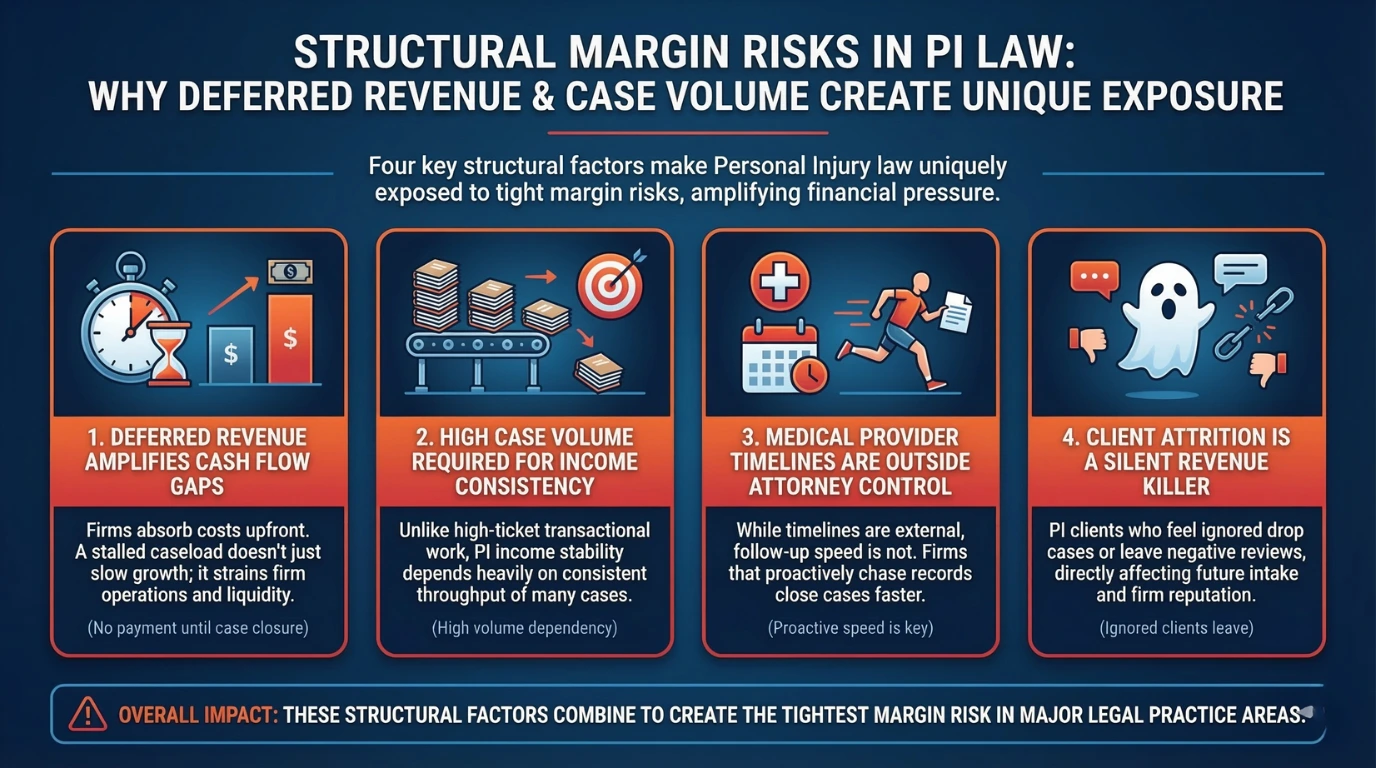
Four structural factors make PI law uniquely exposed to margin risk:
- Deferred revenue amplifies cash flow gaps; a stalled caseload does not just slow growth, it strains firm operations.
- High case volume is required for income consistency unlike high-ticket transactional work, PI income stability depends on throughput.
- Medical provider timelines are outside attorney control, but follow-up speed is not. Firms that chase records proactively close faster.
- Client attrition is a silent revenue killer, PI clients who feel ignored drop cases or leave negative reviews that affect future intake.
How High-Earning PI Attorneys Are Structured Differently
Attorneys at the top of the personal injury lawyer salary range have solved the same operational problem. They have built practices where attorneys do legal work and trained support staff handle everything else without exception.
The operational patterns common among high-earning PI attorneys:
- Hard task separation intake coordination, records retrieval, adjuster correspondence, and client updates never sit on an attorney's desk.
- Proactive case pipeline management cases are tracked at every stage with structured follow-up, not managed reactively when deadlines appear.
- Scalable support capacity support staffing grows with caseload volume, so attorneys never become the bottleneck in their own practice.
- Standardized intake systems Consistent client onboarding reduces early-stage drop-off and shortens the gap between signed retainer and active case management.
The result is not just higher individual income. It is a firm that can grow without the attorney working more hours.
What Sets Our Remote Case Managers Apart
Not all remote support is equal. RemoteCaseManager.com's personal injury case management team is pre-vetted, trained by U.S.-based attorneys, and dedicated full-time to your firm 40 hours per week, not freelance or project-based.
- Experienced in PI-specific workflows: medical records, lien resolution, demand letters, adjuster communication
- Bilingual English and Spanish-speaking professionals available
- Month-to-month billing, no long-term contracts
- Fully integrated into your existing case management software under attorney supervision
Frequently Asked Questions
1. How much does a personal injury lawyer make per year?
Personal injury lawyers earn between $80,000 and $250,000 annually on average, with senior attorneys and top-volume trial lawyers exceeding $500,000. Income depends on experience, caseload, and contingency case outcomes.
2. Are personal injury lawyers among the highest paid lawyers?
Yes. Senior PI attorneys who run high-volume contingency practices often out-earn salaried corporate lawyers. PI law saw the highest salary growth of any legal specialty in 2025, with an 11% increase.
3. What percentage do personal injury lawyers take from a settlement?
PI attorneys typically charge 33% of the settlement if the case resolves before trial and up to 40% if the case goes to court. Fee structures vary by firm, state, and case complexity.
4. How do remote case managers help personal injury law firms increase revenue?
Remote case managers handle records, adjuster calls, and client updates so attorneys close more cases. Faster turnaround and higher caseload capacity translate directly to increased settlement revenue.
5. What is the difference between a remote case manager and a paralegal for a PI firm?
Paralegals assist with legal research and document drafting under attorney supervision. Case managers own the coordination and communication layer tracking cases, chasing records, and managing client relationships.









.webp)




.webp)


%20(1).webp)





















%20(2)%20(2).avif)
.avif)