.webp)
The terms paralegal and legal assistant are often used interchangeably. But the legal industry has moved toward a formal distinction between the two. Paralegals perform substantive legal work. Legal assistants focus on administrative support.
The difference matters more than most firms realize. Mixing up the roles leads to misassigned tasks, billing gaps, and compliance risk. Under ABA Model Rule 5.3, attorneys are personally liable for what their non-lawyer staff does.
This guide breaks down each role by duties, education, salary, and when to hire which. If your attorneys are handling work that support staff could own, you are likely understaffed in the wrong area.
Key Takeaways
- Paralegals generate billable hours for the firm. Legal assistants do not.
- The ABA updated its paralegal definition in 2020 to remove the term "legal assistant," formally separating the two roles.
- Misassigning tasks between these roles creates compliance risk. Under ABA Model Rule 5.3, attorneys are personally responsible for non-lawyer staff conduct.
- Both roles can work remotely, and 82% of paralegals already do in some capacity, according to the ABA.
What Is a Legal Assistant?
A legal assistant is an administrative professional who keeps a law office running. They are not primarily responsible for legal work. Their value is operational.
The Association of Legal Administrators (ALA) defines legal assistants as professionals whose work includes administrative and secretarial tasks to assist an attorney, with some duties overlapping with paralegals depending on firm size.
Common legal assistant responsibilities:
- Scheduling client appointments and managing attorney calendars
- Answering phones and handling client intake communications
- Organizing and maintaining case files and records
- Drafting and proofreading routine correspondence
- Managing billing, invoicing, and payment follow-ups
- Filing court documents and coordinating logistics
In smaller firms, legal assistants sometimes absorb tasks that would belong to a paralegal in a larger practice. That overlap is where role confusion starts, and where compliance risk quietly builds.
Legal assistants are also referred to as legal secretaries or administrative assistants. The titles vary by firm, but the scope of the work is the same: keep the office organized so attorneys can focus on clients.
What Is a Paralegal?
A paralegal is a trained legal professional who performs substantive case work under direct attorney supervision. They work on the legal side of the case, not just the operational side.
The American Bar Association (ABA) defines a paralegal as someone "qualified by education, training or work experience who is employed or retained by a lawyer, law office, corporation, governmental agency or other entity and who performs specifically delegated substantive legal work for which a lawyer is responsible." In 2020, the ABA removed the term "legal assistant" from this definition to more accurately reflect the scope of paralegal work.
Common paralegal responsibilities:
- Legal research on case law, statutes, and regulations
- Drafting motions, pleadings, briefs, and discovery documents
- Preparing for depositions, mediations, and trial
- Interviewing clients and coordinating with witnesses
- Managing discovery and document review
- Communicating with clients on case status and legal procedures
Paralegals often specialize in a practice area. Personal injury, immigration, real estate, corporate law, criminal defense, and workers' compensation are the most common. A specialist paralegal brings real depth to a high-volume firm.
One important distinction for firm owners: paralegals bill their time. According to Clio's 2024 Legal Trends Report, the average attorney completes just 2.9 hours of billable work per day. A paralegal absorbs the non-billable case prep that pulls that number down.
Where the Roles Overlap and Where They Do Not
The overlap is real, especially in smaller firms. Both roles handle some form of document preparation and client communication. Both support attorneys. Both work in legal environments.
But the line that cannot be crossed is this: only a paralegal performs substantive legal work, and only under attorney supervision. A legal assistant cannot draft a legal argument, analyze case law, or conduct a client interview for case strategy purposes.
Where they overlap:
- Preparing and organizing case files
- Drafting routine correspondence
- Communicating with clients on administrative matters
- Assisting with trial logistics
Where they do not:
- Legal research and case analysis (paralegal only)
- Drafting motions, pleadings, and legal briefs (paralegal only)
- Interpreting legal documents for clients (paralegal only)
- Scheduling and calendar management (legal assistant primary)
- Billing and invoicing (legal assistant primary)
Neither role can give legal advice, represent a client, or sign court documents. Those tasks belong to licensed attorneys only. Assigning them to anyone else constitutes the unauthorized practice of law.
Under ABA Model Rule 5.3, if a legal assistant or paralegal crosses a line, the attorney supervising them is held accountable. Location does not change that. Remote staff are covered by the same rules as in-office staff.
Education and Certification Requirements
Legal Assistant Education
Most legal assistants enter with a high school diploma and learn on the job. Some firms prefer candidates with a certificate in legal studies, an associate's degree, or prior administrative experience in a legal setting.
Formal certification is not required but can help with advancement:
- Certified Legal Assistant (CLA) from NALA
is a professional designation offered by the National Association of Legal Assistants (NALA). It is synonymous with the Certified Paralegal (CP) credential; both titles are used interchangeably to signify that a legal professional has met high national standards of competence.
- Professional Legal Secretary (PLS) from NALS
is a prestigious national certification offered by NALS (the National Association for Legal Support Professionals). It is designed for experienced legal support staff who want to demonstrate mastery in office skills, legal knowledge, and professional judgment.
Paralegal Education
Paralegals typically need an associate's or bachelor's degree in paralegal studies. Some employers also accept a degree in any subject combined with a paralegal certificate from an ABA-approved program.
Key certifications for paralegals:
- CP (Certified Paralegal) from NALA, the most widely recognized
widely considered the "gold standard" for paralegals. It is the only paralegal certification accredited by the National Commission for Certifying Agencies (NCCA).
- RP (Registered Paralegal) from NFPA
is a professional credential awarded by the National Federation of Paralegal Associations (NFPA). It is earned by passing the Paralegal Advanced Competency Exam (PACE), which is designed for experienced paralegals rather than those just entering the field.
- AACP (American Alliance Certified Paralegal) from AAPI
is a distinctive national certification offered by the American Alliance of Paralegals, Inc. (AAPI).
According to the U.S. Bureau of Labor Statistics, the median annual wage for paralegals and legal assistants was $60,970 as of May 2023, with employment expected to grow steadily through 2032.
One state note: California has specific regulatory requirements for paralegals that differ from most other states. If your firm handles employment law or other regulated practice areas in California, verify the state requirements before posting a role.
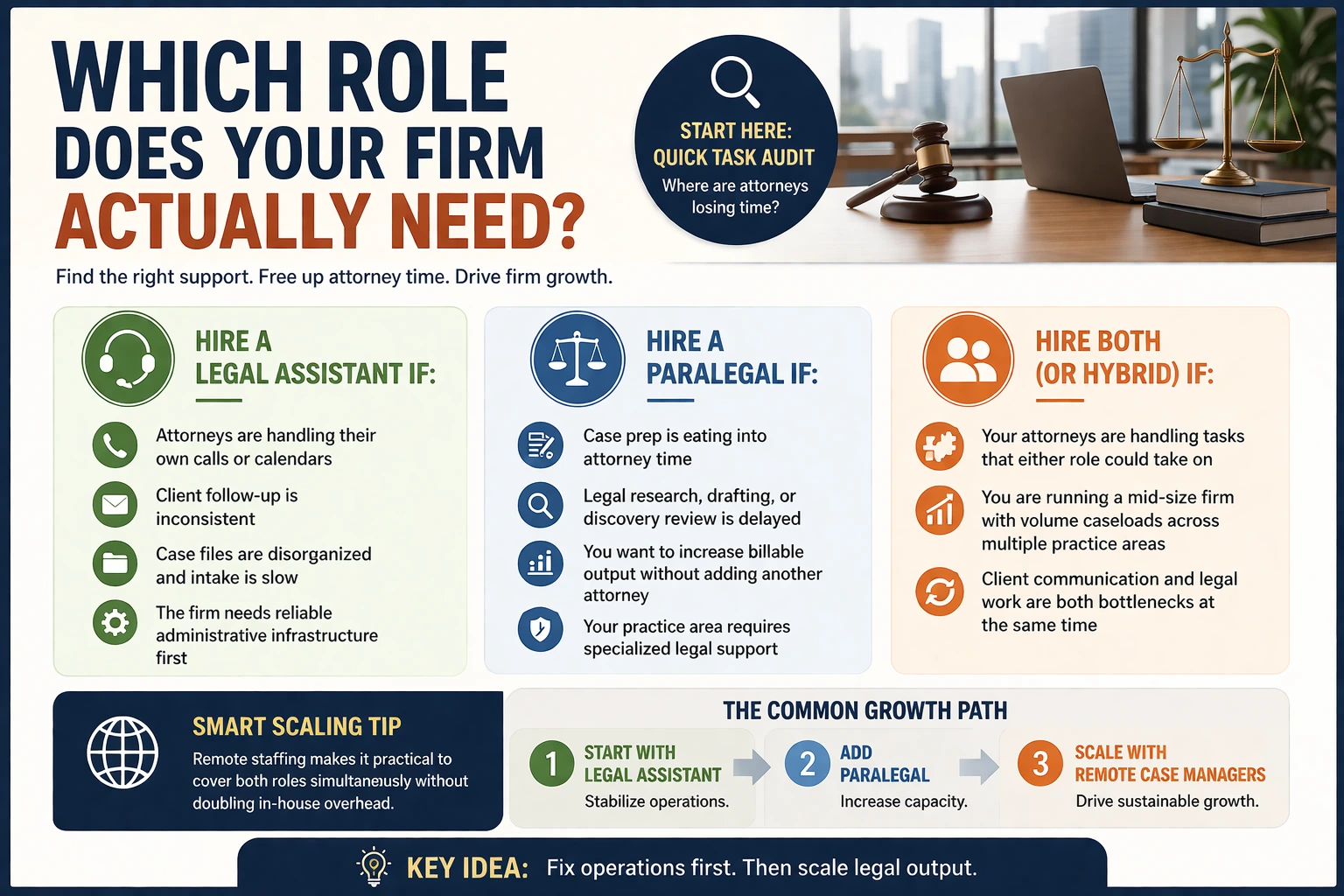
Which Role Does Your Firm Actually Need?
This comes down to where your attorneys are losing time. Run a quick task audit before posting any job listing.
Hire a legal assistant if:
- Attorneys are answering their own phones or managing their own calendars
- Client follow-up is inconsistent or falling behind
- Case files are disorganized and intake is slow
- The firm needs reliable administrative infrastructure before anything else
Hire a paralegal if:
- Case prep is eating into attorney time
- Legal research, drafting, or discovery review is delayed
- You want to increase billable output without adding another attorney
- Your practice area requires specialized legal support (litigation, immigration, PI, etc.)
Hire both (or consider a hybrid role) if:
- Your attorneys are handling tasks that either role could take on
- You are running a mid-size firm with volume caseloads across multiple practice areas
- Client communication and legal work are both bottlenecks at the same time
Many firms find that remote staffing makes it practical to cover both roles simultaneously without doubling in-house overhead.
Many growing firms start with a legal assistant to stabilize operations, then add paralegal support as caseload increases. Adding remote case managers alongside either role is the most common growth path for small to mid-size practices.
Can Legal Assistants and Paralegals Work Remotely?
Both roles can perform their full scope of work remotely. The legal profession has already moved in this direction. According to the ABA's study on remote paralegals, 82% of paralegals work remotely in some capacity, with 32% fully remote.
Remote work does not change the rules. Under ABA Model Rule 5.3, attorneys remain responsible for non-lawyer staff conduct regardless of location. Supervision requirements, task boundaries, and confidentiality obligations apply the same way they do for in-office staff.
What changes is cost. Remote legal assistants and paralegals eliminate most fixed overhead while maintaining the same output. There is no office space, no equipment budget, and no local geography limiting your candidate pool.
What to look for in a remote legal hire:
- Verified legal experience in your practice area
- Familiarity with your case management software (Clio, Filevine, MyCase, SmartAdvocate)
- A structured onboarding process so they integrate into your workflow quickly
- Bilingual capability if your firm serves Spanish-speaking clients
Already Know Which Role You Need? Here Is How Firms Are Hiring Both Remotely
Law firms across all 50 states are replacing in-house legal support with pre-vetted remote staff, and the math makes the decision straightforward.
An in-house legal assistant at $45,000 annually costs the firm closer to $60,000 when you add benefits, payroll taxes, and overhead. A remote legal assistant through Remote Case Manager starts at $13/hr, already trained on legal workflows, bilingual, and ready to work in your existing software on day one.
Remote Case Manager places legal assistants, paralegals, case managers, and intake specialists directly into law firms. Every candidate is attorney-trained and experienced with Clio, Filevine, MyCase, and SmartAdvocate before they start. No recruiting lag. No onboarding guesswork.
- Legal Assistants starting at $13/hr for calendar management, intake, client follow-up, and document organization
- Paralegals starting at $17/hr for legal research, drafting, discovery, and trial prep
- Intake Specialists starting at $13/hr for lead qualification and client communication
- Case Managers for end-to-end case tracking and attorney support
Firms using Remote Case Manager cut overhead by up to 70% compared to in-house hiring, according to their platform data. Over 1,000 law firms across the U.S. have used the service.
Frequently Asked Questions
Can a paralegal give legal advice to clients?
No. Paralegals work under attorney supervision and cannot advise clients, represent parties in court, or sign legal documents. Doing so is unauthorized practice of law.
Are "paralegal" and "legal assistant" the same job title?
Not officially. The ABA updated its definition in 2020 to distinguish paralegals as performing substantive legal work. Some firms still use the titles interchangeably, but the roles carry different responsibilities, billing implications, and compliance requirements.
Should I hire a paralegal or a legal assistant first?
Audit where your attorneys are losing time. If it is admin and scheduling, start with a legal assistant. If it is case prep, research, or drafting, you need a paralegal.
Can a legal assistant transition into a paralegal role?
Yes. Many legal assistants gain experience on the job, complete a paralegal certificate program, and move into paralegal positions. It is one of the most common career paths in legal support.
Do remote paralegals and legal assistants require the same supervision as in-office staff?
Yes. ABA Model Rule 5.3 applies regardless of where the work is performed. Attorneys remain responsible for non-lawyer staff conduct whether that person is in the office or working remotely from another state.
The Bottom Line: Know the Difference Before You Hire
Legal assistants and paralegals serve different functions, carry different costs, and operate under different compliance standards. Using the titles interchangeably is where most staffing mistakes begin.
Understanding the distinction helps firms assign tasks correctly, protect attorneys from liability, and build a support structure that matches the actual workload.









.webp)






%20(1).webp)






















%20(2)%20(2).avif)
.avif)