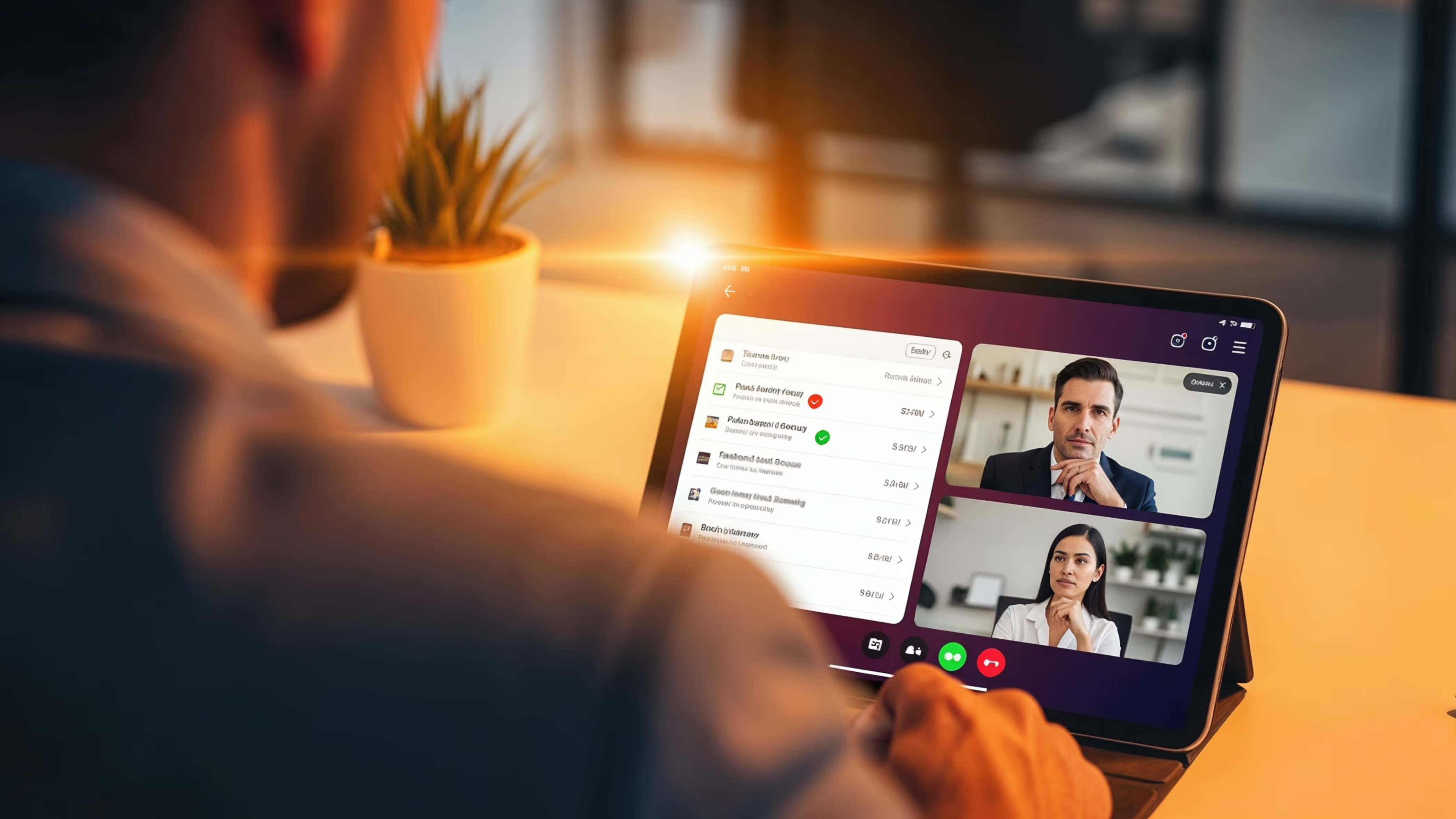
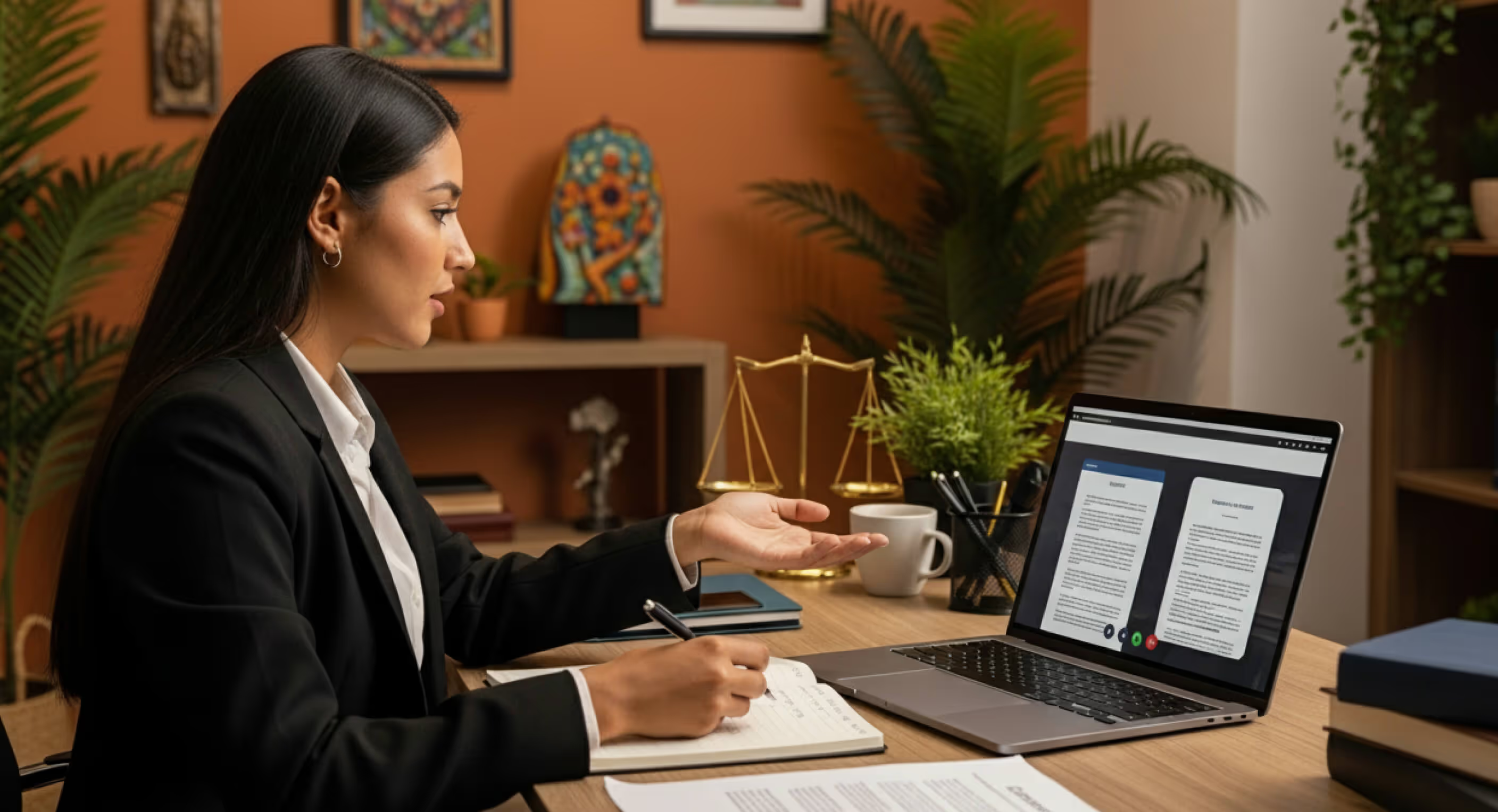
Yes, paralegals can work from home. The legal profession has already moved in that direction, and the data backs it up.
According to the ABA's Landscape of Remote Paralegals study, 82% of paralegals work remotely in some capacity, with 32% working fully remote. Only 14% do not work remotely at all.
For law firm owners and managers, the real question is not whether it's possible. It's whether your firm has the right structure to make it work without gaps in oversight, security, or output quality.
Key Takeaways
- Paralegals can work remotely with active attorney supervision.
- 82% of paralegals work remotely in some capacity (ABA study).
- ABA Model Rule 5.3 applies regardless of location.
- Remote paralegals perform the same legal tasks as in-office staff with proper tools and oversight.
What a Remote Paralegal Actually Does
A remote paralegal is a trained legal professional who performs substantive case support work from a non-office location, always under the direct supervision of a licensed attorney.
The role is not a watered-down version of in-office support. The tasks are the same. Only the location changes.
Core tasks a remote paralegal handles:
- Legal research and case law review
- Drafting and proofreading legal documents
- Organizing and maintaining case files
- Client and witness communication
- Discovery preparation and exhibit organization
- Deadline tracking and matter management
- Court filing coordination through electronic portals
Remote Paralegal vs. Virtual Legal Assistant
These two roles get mixed up often, and it costs firms time when they hire the wrong profile.
If your firm needs someone to draft motions or manage discovery, that is a paralegal role. If you need someone to manage your calendar and follow up with clients, that is a legal assistant role. Both can be remote. Both require different qualifications.
Is It Legal? What ABA Rules Say About Remote Paralegal Work
Remote paralegal arrangements are fully legal and ethically sound when firms follow the existing professional conduct framework.
Under ABA Model Rule 5.3, attorneys are responsible for the conduct of nonlawyer assistants regardless of where the work is performed. Location does not change supervision requirements, permissible tasks, or attorney accountability.
What this means in practice for your firm:
- You assign specific tasks to the paralegal and review their output before it goes to clients or courts.
- The paralegal works within the scope you define. They do not advise clients independently or make legal decisions.
- Your firm is responsible for any breach of confidentiality, even if it occurs on the paralegal's end.
- Conflict-of-interest screening must happen before any paralegal is onboarded, remote or otherwise.
The key ethical boundary to hold: paralegals can handle preparatory and administrative legal work, but they cannot practice law. They cannot advise clients, set fees, appear in court, or sign engagement agreements without attorney involvement.
The NALA Model Standards and Guidelines for Utilization of Paralegals put it clearly: the attorney must delegate work based on the paralegal's education and abilities, then monitor the work product to ensure it is substantively correct and professionally executed.
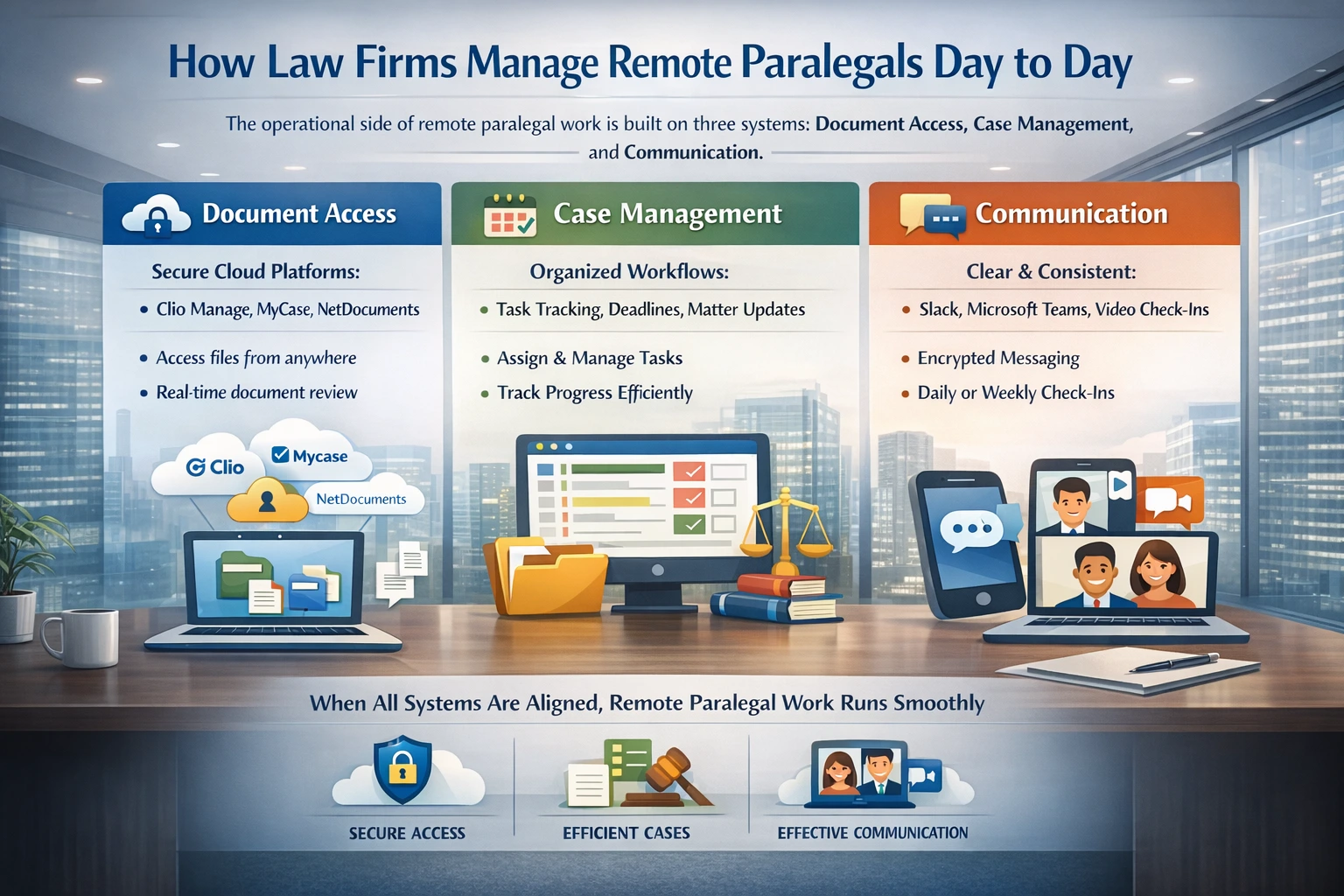
How Law Firms Manage Remote Paralegals Day to Day
The operational side of remote paralegal work is built on three systems: document access, case management, and communication. When all three are in place, remote work functions just like in-office support.
Document Access
Cloud-based legal document systems like Clio Manage, MyCase, and NetDocuments give remote paralegals secure access to case files from any location. Files are stored in encrypted cloud environments, so no sensitive data sits on a personal device.
Attorneys can log in to review, approve, or annotate documents in real time. Nothing leaves the platform without authorization.
Case Management
Practice management platforms keep tasks, deadlines, and matter statuses visible to both the attorney and the paralegal. Attorneys assign work directly inside the system. Paralegals update progress. No detail gets lost in an email thread.
The most widely used legal platforms for remote teams are covered in detail in the top legal document management tools guide on the RemoteCaseManager.com blog.
Communication
Encrypted email, dedicated case channels in tools like Slack or Microsoft Teams, and scheduled video check-ins keep the attorney-paralegal relationship intact. The goal is not constant monitoring. It is structured, predictable contact.
Most firms that succeed with remote paralegals run brief daily or per-matter check-ins. These do not need to be long. A 10-minute video call or a quick status message in a case channel is enough to keep things on track.
The Real Costs and Savings of Remote Paralegal Support
Cost is one of the first reasons firms look at remote staffing. The savings are real, but they work differently than most people expect.
According to the U.S. Bureau of Labor Statistics, the median annual wage for paralegals and legal assistants was $60,970 as of May 2023. Add employer-side costs like benefits, payroll taxes, equipment, and office space, and the total cost of an in-house paralegal climbs well above that figure.
Remote paralegals reduce or eliminate most of those fixed costs. You are paying for the work, not for the desk.
Where firms typically save:
- No office space or equipment allocation
- Reduced benefits overhead compared to full-time in-house hires
- Faster onboarding when working with pre-vetted, experienced staff
- Scalable support that adjusts with caseload volume
The Clio Legal Trends Report found that the average attorney completes just 2.9 hours of billable work per day. A dedicated remote paralegal absorbs the non-billable task load that is eating into that number, which directly affects revenue without requiring a single additional attorney hire.
What to Look for When Hiring a Remote Paralegal
Most firms hire remote paralegals the same way they hire in-office staff. That is the first mistake. Remote work requires a specific profile, not just legal experience.
Qualifications that matter for remote roles:
- Documented experience in your practice area: PI, estate planning, corporate, employment, or workers' compensation
- Comfort with your case management and document tools (Clio, MyCase, Filevine, etc.)
- Clear communication habits. Do they proactively flag issues, or wait to be asked?
- Strong time management. Remote work requires self-direction that not every paralegal develops in an office environment.
- Conflict-of-interest clearance before they touch a single file
Conflict screening is not optional. It is an ethical obligation under both ABA and state bar guidelines. Any paralegal who has previously worked at a firm with an adverse interest to your current client creates a conflict that must be identified and addressed before work begins.
Experience level matters, but location of that experience does not. Many of the most capable remote paralegals have years of law firm experience and simply prefer working offsite. The profile to avoid is someone who has never worked in a legal environment at all, regardless of how remote-ready they appear.
How Remote Case Manager Supports Law Firms with Dedicated Remote Staff
RemoteCaseManager.com places full-time, dedicated, pre-vetted case managers with law firms across the U.S. Every staff member is trained by U.S. attorneys, familiar with court rules and legal documentation standards, and ready to work inside your existing case management tools from day one.
Staff work exclusively under attorney supervision, full time and dedicated to your firm. This is not a shared-resource or gig arrangement. Your case manager works your cases, follows your workflows, and reports to you.
What firms get with Remote Case Manager:
- Pre-vetted case managers, paralegals, legal assistants, and intake specialists
- Bilingual staff (English and Spanish) for firms serving diverse client bases
- Flat-rate monthly billing starting at $2,525/month, no long-term contracts
- Ready to use Clio, Filevine, MyCase, and other legal platforms without onboarding delays
Firms across practice areas including workers' compensation and employment law use Remote Case Manager to keep cases moving without adding in-house overhead.
For a breakdown of how remote staffing addresses the broader operational challenges law firms face, see How Remote Staffing Transforms Law Firms.
To see available staff and pricing, visit the trained remote case manager page or the pricing page.
Remote Paralegal Support Works When Your Firm Has the Right Structure
The answer to whether paralegals can work from home is straightforward: yes, and most already do.
What separates firms that benefit from remote paralegals from those that struggle is structure. Clear attorney supervision, the right case management tools, and pre-vetted staff who know legal workflows from day one.
Frequently Asked Questions
Can a Paralegal Legally Work from Home?
Yes. Paralegals can work from home as long as a licensed attorney actively supervises their work and the firm maintains proper confidentiality and data security protocols.
What Tasks Can a Remote Paralegal Handle for a Law Firm?
Remote paralegals can draft legal documents, manage case files, conduct research, prepare discovery materials, track deadlines, and handle client communication, all under attorney direction.
Does ABA Model Rule 5.3 Apply When a Paralegal Works Remotely?
Yes. Rule 5.3 holds attorneys responsible for nonlawyer work regardless of location. Supervision requirements are identical whether the paralegal is in-office or fully remote.
How Do Law Firms Supervise Remote Paralegals Effectively?
Firms use cloud-based case management tools, encrypted communication channels, and structured attorney check-ins to maintain active oversight without requiring in-person presence.
What Is the Difference Between a Remote Paralegal and a Virtual Legal Assistant?
A remote paralegal handles substantive legal work under attorney supervision, while a virtual legal assistant focuses on administrative tasks like scheduling, billing, and client follow-ups.









.webp)




.webp)

%20(1).webp)





















%20(2)%20(2).avif)
.avif)