
Paralegal unemployment sits at roughly 1.9% nationally, one of the lowest rates across all professional occupations. That tight supply means your best paralegal support staff are already being approached by competing firms, legal recruiters, and alternative legal service providers, often before they have even decided to leave.
Law firm staffing has always required planning, but 2026 is different. The demand for litigation paralegals alone is outpacing the available talent pool. The firms that keep good people are not the ones paying the highest salaries. They are the ones that built a retention plan before the resignation landed on their desk.
Key Takeaways
- Paralegal unemployment sits at roughly 1.9% nationally, which means your top support staff are already fielding competing offers.
- Workload overload, unclear career paths, and limited flexibility drive most paralegal departures, not pay alone.
- Partnering with a legal recruiter helps firms fill open roles faster with candidates who are a better fit for long-term retention.
- Remote legal staffing reduces admin overload on in-house paralegals, which directly lowers the burnout that leads to turnover.
Why Paralegals Are Leaving Law Firms Right Now
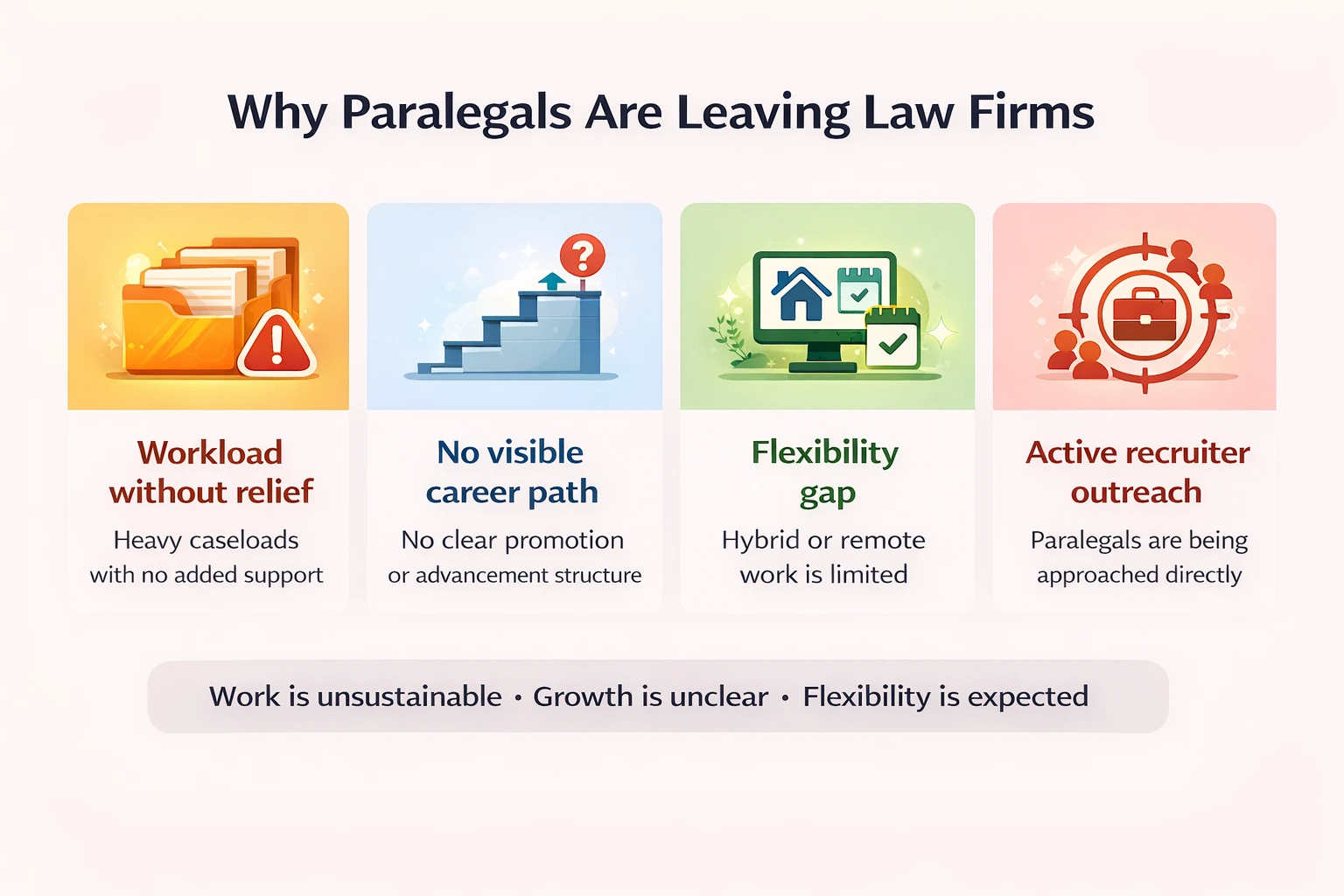
The core issue is not compensation, though pay still matters. Paralegals leave when the work is unsustainable, growth feels invisible, and flexibility is treated as a privilege instead of a policy.
Here are the four most common reasons paralegals walk:
- Workload without relief. Many firms expanded their attorney headcount without adding paralegal support. Paralegals are now routinely handling work previously assigned to junior associates, with no adjustment to their caseload.
- No visible career path. Most firms have no formal advancement criteria for paralegal staff. When a paralegal cannot see what promotion looks like, they find it somewhere else.
- Flexibility gap. According to the Robert Half 2026 Legal Hiring Guide, only about 32% of legal support roles are advertised as hybrid. Most experienced paralegals expect it.
- Active legal recruiter outreach. In a market this tight, legal recruiters are approaching experienced paralegals directly. Your staff may be in conversations with competing firms right now, without you knowing it.
What a Law Firm Staffing Strategy Actually Covers
A law firm staffing strategy is a plan for how a firm recruits, retains, and fills gaps in its legal support staff, including paralegals, case managers, and legal assistants, before turnover creates a crisis.
Most firms operate reactively. A paralegal gives notice, and the hiring process starts from scratch. A proactive strategy has three working parts:
- A talent pipeline that keeps qualified candidates warm before roles open
- Retention policies that address what actually causes people to leave
- Backup staffing options, such as remote legal support, to absorb overflow without burning out in-house staff
This matters more in 2026 because the alternative legal services market reached $28.5 billion. Paralegals now have viable options outside traditional law firms, including remote-first roles, tech-enabled legal operations teams, and project-based legal work. Your retention strategy has to compete with all of it.
Retention Tactics That Work for Paralegal Staff
Give Paralegals a Career Path, Not Just a Job
The most effective retention tool a firm has is showing paralegals exactly where they can go. Firms that implement a tier system with specific advancement criteria, including mentorship participation and skill benchmarks, give paralegals a reason to stay.
One HR director cited by BOS Staffing's 2025 legal retention research reported a 37% reduction in first-year support staff turnover after implementing a structured mentorship program. The structure itself was the retention driver.
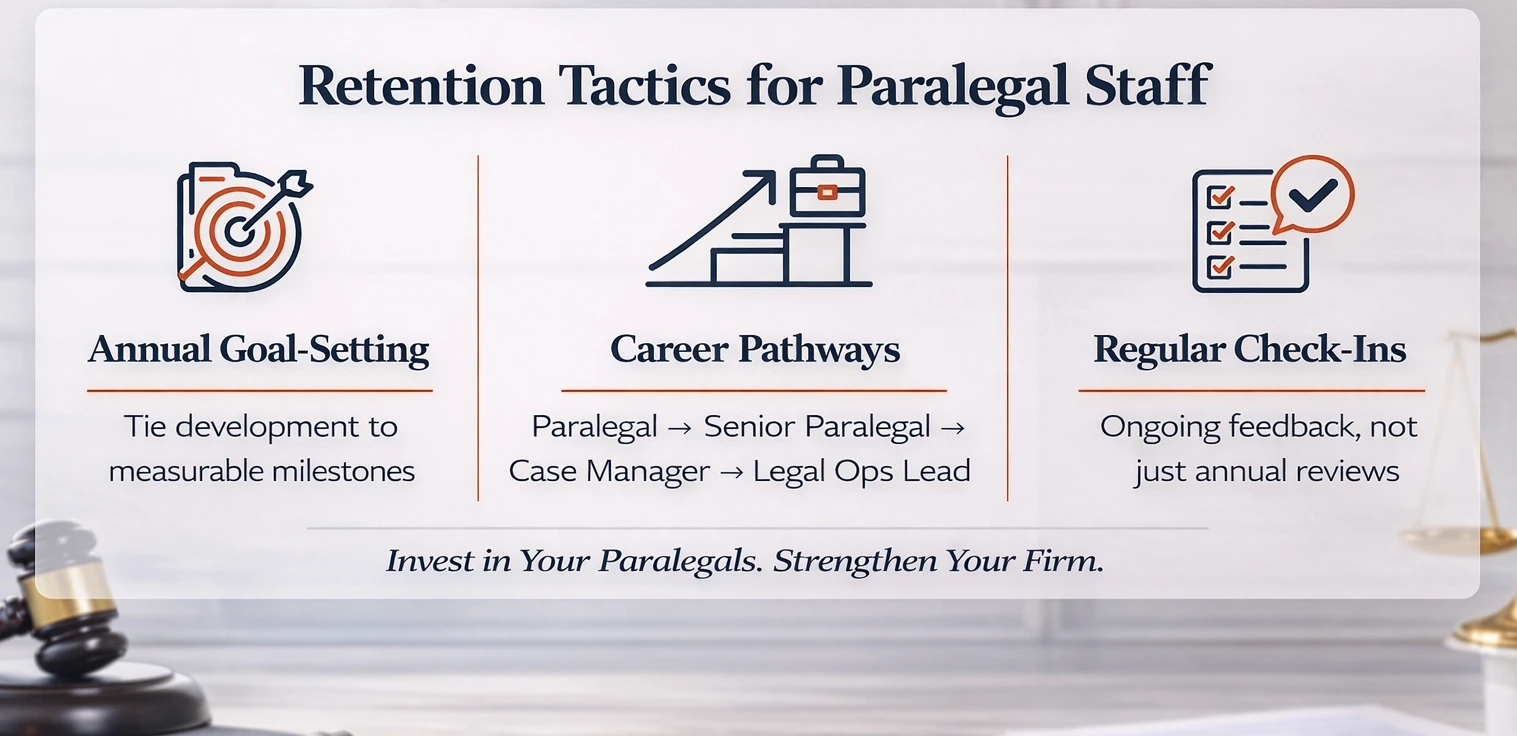
Three things to put in place now:
- Annual goal-setting sessions that tie professional development to measurable milestones
- A defined pathway from paralegal to senior paralegal, case manager, or legal operations lead
- Regular progress check-ins, not just annual reviews
Fix the Workload Before You Lose the Person
Workload is the most immediate flight risk. When one paralegal is covering three attorneys, the question is not whether they will leave, but when.
Adding remote legal support for intake coordination, document preparation, client follow-up, and scheduling gives in-house paralegals back the focus they need for substantive legal work. It also signals to your team that the firm takes workload seriously.
Look for these warning signs before a resignation:
- One paralegal consistently handling caseloads built for two people
- Frequent weekend work with no compensating flexibility during the week
- Paralegals flagging deadlines they cannot meet with current support
Make Flexibility a Policy, Not a Favor
Vague flexibility is worse than no flexibility. When the answer to "can I work from home on Fridays" depends on which partner you ask, it creates resentment faster than a rigid policy would.
Publish a clear hybrid policy. Specify which roles and which task types are eligible for remote or flexible schedules. For paralegals handling document drafting, legal research, and case file organization, remote or hybrid arrangements are entirely viable and increasingly expected.
The Prime Legal 2026 Legal Trends Report found that firms with unclear or inconsistently enforced work policies face higher mid-level paralegal attrition than those with firm-wide, written standards, even when those standards require more office time.
Stay Competitive on Compensation Without Guessing
The Robert Half 2026 Salary Guide puts the median starting salary for paralegals between $55,000 and $87,250 depending on experience level and market. If your last pay review was two years ago, your firm is likely underpaying.
Competitive pay is the entry requirement. Everything else, growth, flexibility, culture, determines whether the candidate accepts and whether the employee stays. Work with a legal recruiter who tracks current market rates rather than benchmarking against what your firm paid in 2023.
When to Work With a Legal Recruiter
Three situations reliably signal that a firm needs outside help from a legal recruiter:
- A paralegal role has been open for more than 60 days with no qualified candidates
- The firm has made multiple bad hires in the same role over the past two years
- There is no internal pipeline of candidates when a senior paralegal gives notice
A good legal recruiter does more than source candidates. They bring real-time compensation benchmarks, pre-screened applicants with verified legal backgrounds, and knowledge of which candidates are actively looking versus passively open to the right opportunity.
Speed matters significantly in this market. Top litigation paralegals typically receive multiple offers within days of beginning a search. A legal recruiter who works exclusively in the legal support space will move faster than a generalist agency and bring candidates who are genuinely qualified, not just available.
How Remote Legal Staffing Fits Into Your Firm's Strategy
Remote legal staffing is not a replacement for in-house paralegals. It fills the administrative gaps that cause burnout, and burnout is the most common precursor to turnover. Remote case managers handle the tasks that pile up fastest: intake coordination, document organization, deadline tracking, client status updates, and scheduling.
Firms working with Remote Case Manager save over $55,000 annually on average compared to hiring an equivalent in-house role, with no overhead for office space, equipment, or benefits. Over 1,000 law firms across all 50 states use pre-vetted remote case managers who are already trained in U.S. legal workflows and major practice management platforms like Clio, Filevine, and MyCase.
Because remote case managers integrate within days rather than months, they can absorb overflow immediately, before your in-house paralegal reaches a breaking point. That is the retention benefit: when your paralegal is not drowning in admin work, they are far less likely to leave. Learn more about how the Remote Case Manager platform connects your firm with legal-trained support staff who are ready to work in your existing systems.
Building a Staffing Model That Holds Up in 2026
No single staffing approach works for every firm. The ones that retain paralegal staff longest tend to combine all three options strategically, matching each to the right situation.
The firms that grow in 2026 are building this combination now. They have career pathways that keep good people, a legal recruiter relationship ready before roles open, and remote legal staffing in place to absorb the volume that would otherwise burn out in-house staff. Planning reactively costs more, in time, money, and the institutional knowledge that walks out the door with every good paralegal who leaves.
The Firms That Keep Good Paralegals Do These Three Things
Paralegal turnover is expensive. Every departure costs the firm in recruiting time, onboarding weeks, and the institutional case knowledge that a long-tenured paralegal carries out the door.
Firms with strong paralegal retention share three habits: they define career growth before someone asks for it, they manage workload before someone burns out, and they have a remote legal staffing option ready before someone gives notice.
Frequently Asked Questions
What is law firm staffing?
Law firm staffing is the process of recruiting, hiring, and managing legal professionals, including paralegals and case managers, to keep a firm's operations and caseload running consistently.
Why is paralegal retention so difficult for law firms?
Paralegals leave when workloads are unmanageable, career growth is unclear, or flexibility is limited. With unemployment near 1.9%, they have strong alternatives and do not wait long for conditions to improve.
What does a legal recruiter do for law firms?
A legal recruiter sources and screens candidates for legal support roles, provides real-time compensation benchmarks, and helps firms fill open positions faster than a public job posting typically allows.
How does remote legal staffing help with paralegal retention?
Remote legal support handles overflow tasks like intake, scheduling, and document prep, reducing the admin burden on in-house paralegals and lowering the burnout that most commonly leads to turnover.
How much can law firms save with remote case managers?
Firms working with pre-vetted remote case managers save over $55,000 annually on average, with no added costs for office space, equipment, benefits, or employer-side payroll overhead.









.webp)




.webp)

%20(1).webp)






















%20(2)%20(2).avif)
.avif)