
Most immigration case managers know the I-130 is the starting line. What they do not always have is a clear system for knowing when a case has stalled, when to escalate, and how to tell clients what is happening before the client calls asking.
As of mid-2026, I-130 petitions for immediate relatives of U.S. citizens take 13 to 15 months via consular processing, or 8 to 14 months when filed concurrently with an I-485 for adjustment of status. That window only applies when the case moves cleanly through the standard process.
A single missing document triggers a Request for Evidence (RFE) that adds 3 to 5 months. A beneficiary from a policy-flagged country faces an indefinite hold. A petitioner who moves without updating USCIS can miss an RFE notice entirely.
Family preference categories like F3 and F4 run on a completely different timeline. Wait times of 15 to 22 years are common, driven by annual visa caps and country-of-origin backlogs rather than USCIS workload alone.
For case managers handling 20, 30, or 40 active I-130 petitions at once, knowing the baseline numbers is only part of the job. The other part is building a tracking system that catches deviations before the client does.
Key Takeaways
- Immediate relative I-130s take 13 to 15 months (consular processing) or 8 to 14 months (concurrent I-485) in 2026.
- One RFE adds 3 to 5 months. It is the most common and most preventable delay.
- Family preference categories take 4.5 to 22+ years. Visa availability drives the timeline, not USCIS processing speed.
- Delay tracking needs a documented system. Baselines, weekly checks, and escalation tiers prevent cases from falling through.
What Is the I-130 Processing Time in 2026?
The I-130 processing time depends on two things: the petitioner's status (U.S. citizen vs. lawful permanent resident) and the family relationship category. These two factors determine whether a case follows the immediate relative track or a family preference category.
Note on the F1 vs. F2A disparity: F1 (Unmarried Adult Children of U.S. Citizens) shows longer wait times than F2A (Spouses and Children of LPRs) because annual visa cap allocations favor the F2A category. Despite having a U.S. citizen petitioner, which is generally a stronger basis, adult unmarried children compete in a numerically smaller annual pool, driving their priority date backlogs beyond those of some LPR-sponsored relatives.For immediate relatives, the standard process clock starts at filing and runs until USCIS issues its decision. For family preference categories, petition approval is only step one. The beneficiary then waits for their priority date to become current on the monthly Visa Bulletin, which can take years.
Under a January 2026 USCIS policy memorandum, USCIS paused adjudication for nationals of certain designated countries.
Why Tracking Delays Is a Case Manager's Job
Immigration attorneys set strategy. Case managers keep the cases moving. That division only works when case managers have systems that catch problems early.
Here is what happens without one:
- A case sits two months past its expected processing window with no flag in the file.
- The client calls. The attorney scrambles. Time gets spent explaining something that should have been communicated weeks ago.
- An RFE arrived. No one saw it. The 87-day response window is now 60 days shorter.
None of those situations are catastrophic on their own. But they compound across a caseload of 30 or 40 active I-130 petitions. Client trust erodes. Attorneys spend non-billable time managing fallout. And in an RFE scenario, the firm carries real legal risk.
According to the 2024 Clio Legal Trends Report, 59% of legal clients say timely communication is the most important factor in their satisfaction with a firm. That is not an attorney function at scale. It is a case management function.
The firms that handle I-130 caseloads well treat delay tracking as a structured workflow. The ones that struggle treat it as a task someone will get to.
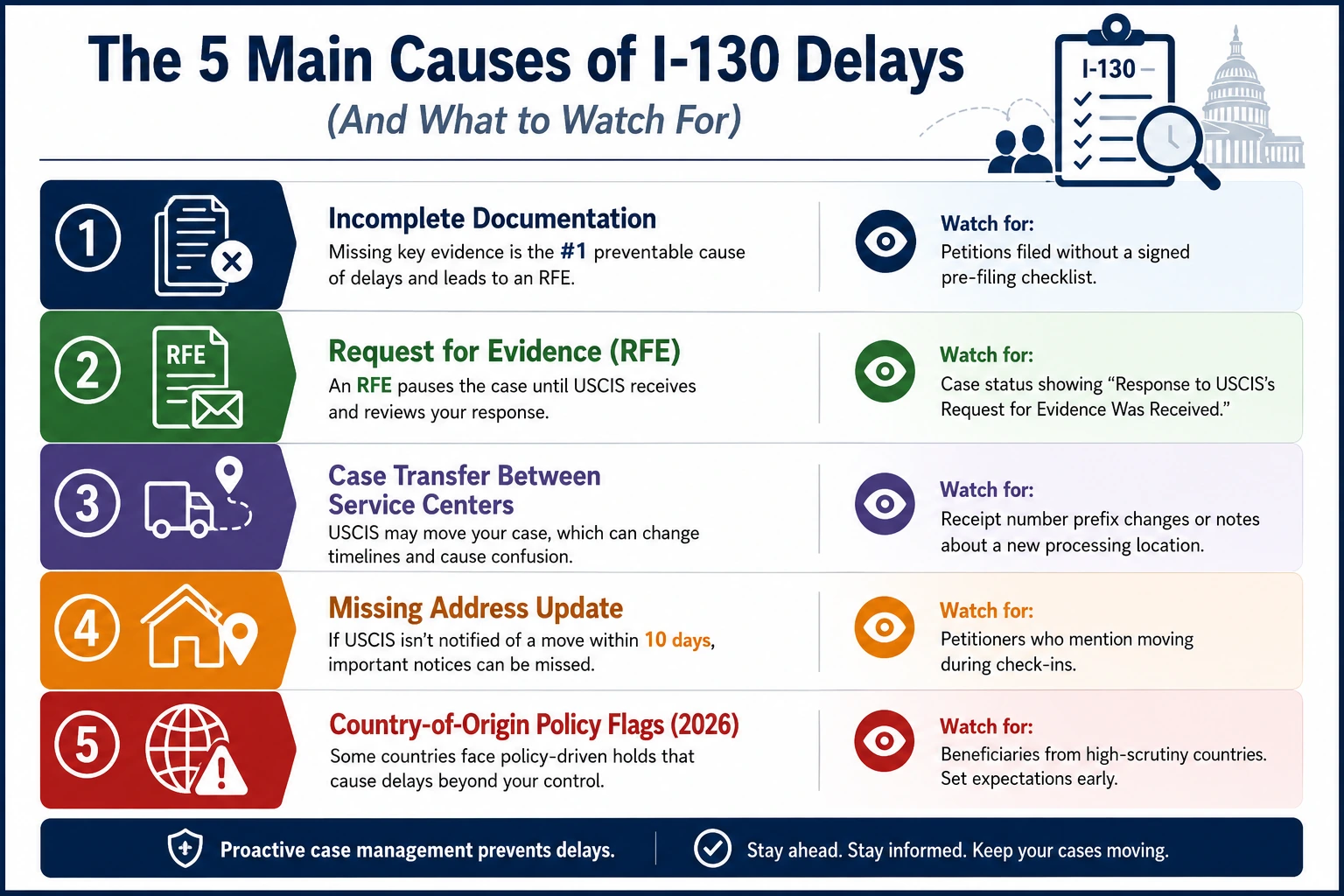
The 5 Main Causes of I-130 Delays (And What to Watch For)
1. Incomplete Documentation at Filing
This is the most common and most preventable cause of delay. Missing relationship evidence, such as marriage certificates, birth records, or financial support documents, triggers a Request for Evidence (RFE) from USCIS.
An RFE adds 3 to 5 months to processing time on average, and that assumes a prompt, complete response.
Watch for: Petitions leaving the firm without a signed pre-filing checklist reviewed by the case manager.
2. Request for Evidence (RFE)
An RFE stops the processing clock entirely. USCIS will not adjudicate the case until it receives and reviews the response. The response window is typically 87 days (verify the current window at USCIS.gov before each response, as this has changed by policy memo in prior years), but waiting until day 80 still adds weeks to the overall timeline.
Watch for: USCIS case status updates that show "Response to USCIS's Request for Evidence Was Received." This means an RFE was already issued. If no one flagged it at issuance, the response window may be compressed.
3. Case Transfer Between Service Centers
USCIS periodically redistributes caseloads between service centers. A transfer can change the applicable processing timeline and create confusion about which center's current estimates apply to the case.
Watch for: Receipt number prefix changes or case status notes referencing a new processing location.
4. Missing Address Update
If a petitioner moves without notifying USCIS within 10 days, USCIS notices go to the wrong address. A missed RFE or appointment notice can effectively restart the process.
Watch for: Any case where the petitioner mentioned moving during routine check-ins, even casually.
5. Country-of-Origin Policy Flags (2026)
Under the 2026 policy memo, some cases have been placed on an adjudication hold based on the beneficiary's country of origin. These delays are policy-driven, not documentation-driven, and cannot be resolved by submitting additional evidence.
Watch for: Cases with beneficiaries from high-scrutiny countries. Set client expectations early. These delays require a different communication approach than a standard processing lag.
How to Build a Practical I-130 Delay Tracking System
A good tracking system does not require custom software. It requires discipline about what gets logged, when, and what happens next.
Step 1: Set a Baseline on Filing Day
The moment an I-130 is submitted, record the following in the case file:
- Filing date
- Service center (from receipt notice prefix)
- Beneficiary category (immediate relative vs. family preference)
- Concurrent I-485 filed: yes or no
- Expected processing window (pull from USCIS processing times tool on filing day)
- Calculated "outside normal processing" trigger date
That last field matters most. It converts USCIS's published window into a specific calendar date. When the case passes that date with no decision, the escalation protocol starts automatically. No guessing required.
Step 2: Schedule Weekly USCIS Status Checks
Manual status checks do not scale across a full caseload. At a minimum, assign each active I-130 a fixed weekly check day. Log the result, even if it is "no update." A documented pattern of no movement is evidence if a mandamus inquiry becomes necessary later.
Automate this wherever possible using legal case management software with immigration integrations. Dedicated platforms reduce the manual check burden significantly.
Step 3: Use a Three-Tier Escalation Protocol
Not every delay needs the same response. Define clear thresholds before a case goes out-of-window:
Step 4: Standardize Client Communication at Each Tier
Proactive communication prevents inbound calls. Each tier should have a default communication template:
- Tier 1: Monthly status email (automated or templated)
- Tier 2: Personal call or email noting the delay and next steps
- Tier 3: Written update explaining the delay type, options, and the firm's action plan
The tone at Tier 3 matters. Policy-driven delays (country-of-origin holds) need different language than documentation delays. Clients who understand why a case is delayed are less likely to feel the firm is not doing its job.
Step 5: Document Everything
Every USCIS status check, client communication, RFE log, and address update needs a timestamp and a home in the case file. This protects the firm, supports any future inquiry or mandamus action, and gives supervising attorneys a clean audit trail.
For firms looking to scale this without adding in-house headcount, remote case managers trained in immigration law can implement and maintain this workflow from day one.
Tools Case Managers Use to Track I-130 Status
You do not need a complex system to track USCIS processing times effectively. Here are the main tools in use at immigration law firms in 2026:
- USCIS Case Processing Times Tool: Free, official, updated monthly. Use this to set baselines at filing. Do not rely on it for real-time individual case status.
- USCIS Case Status Online: Check by receipt number. Shows current case milestone (received, RFE sent, approved, etc.). Free and essential.
- Immigration case management platforms: Purpose-built tools that integrate USCIS status monitoring, deadline alerts, and client communication. Best for firms handling high-volume immigration caseloads.
- Practice management software with immigration integrations: General legal practice tools paired with immigration-specific add-ons.
- Shared case tracking logs: A minimum viable option for smaller firms. A structured spreadsheet with weekly review protocols can work if maintained consistently.
Regardless of the tool, the process still depends on a case manager who logs consistently, checks on schedule, and acts on triggers. The tool does not replace the system. It supports it.
For firms that want expert-level tracking without building the infrastructure internally, see how law firms structure their immigration case management workflows with remote support.
When a Delay Becomes a Legal Problem
Most I-130 delays are frustrating but manageable. Some cross into territory that requires legal action.
If a case is significantly outside the normal USCIS processing window with no explanation, the options are:
- USCIS Online Inquiry: File an e-Request through the USCIS website when a case exceeds the published processing time.
- Ombudsman Complaint: Contact the USCIS Ombudsman office for cases with documented, prolonged inaction.
- Congressional Inquiry: A client's congressional representative can submit a formal status inquiry to USCIS on their behalf.
- Writ of Mandamus: A federal lawsuit compelling USCIS to act on an unreasonably delayed case. A writ of mandamus does not guarantee approval but compels the agency to act, and federal courts have consistently recognized it as a remedy for unreasonable USCIS delay.
Case managers should know these options exist and document delay timelines carefully so attorneys can evaluate them when needed. This is also where thorough case file documentation pays off directly.
How Remote Case Managers Support I-130 Tracking
Immigration law firms face a staffing tension. Tracking 40 active I-130 petitions weekly takes consistent time. Adding that responsibility to an attorney's plate is not efficient. Hiring a full-time in-house case manager for immigration-specific tracking is expensive.
Remote case managers trained in immigration workflows sit between those two options. They handle weekly USCIS status checks, log case milestones, flag out-of-window cases, draft client updates, and maintain the documentation standards attorneys need.
This is a staffing solution that makes the tracking system in this post actually run. Firms that have added dedicated immigration case managers to their support team report fewer missed RFE windows, fewer client complaint calls, and better caseload visibility for supervising attorneys.
If your firm manages I-130 cases without a structured tracking system, the workflow above is the starting point. If you need someone to run it, explore what a remote case manager for immigration law firms can do for your team.
Frequently Asked Questions
What is the processing time for I-130 in 2026?
As of mid-2026, USCIS processes I-130 petitions for immediate relatives of U.S. citizens in approximately 10 to 15 months via consular processing, and 8 to 14 months when filed with a concurrent I-485 adjustment of status application inside the U.S.
How can I get an I-130 approved faster?
File a complete, error-free petition with all required documents at submission. Respond to any RFE immediately. File concurrently with I-485 when eligible. USCIS does not offer premium processing for I-130 petitions. Expedite requests are considered on a case-by-case basis for documented emergencies or severe hardship.
Does an approved I-130 mean no interview is required?
No. I-130 approval confirms the qualifying family relationship. It does not determine interview requirements for subsequent steps. Adjustment of status applicants may still be scheduled for a USCIS field office interview. Consular processing applicants will have an embassy or consulate interview abroad.
Can an RFE cause a case to be denied?
Yes. Failing to respond within the deadline or submitting an incomplete response can result in denial. An RFE is a pause, not a rejection, but it becomes one if the response is inadequate or late. Responding fully and promptly is critical.
What happens when an I-130 case is outside normal processing time?
File a USCIS online case inquiry once the case exceeds the published processing window. If inaction continues, options include a congressional inquiry, USCIS Ombudsman complaint, or a writ of mandamus. Document all delay dates in the case file before escalating.
Managing I-130 Delays Comes Down to Workflow
The USCIS processing time for I-130 petitions is not something a law firm controls. What the firm does control is whether delays get caught early, whether clients get proactive communication, and whether the file is documented well enough to support escalation when it is needed.
The case managers who handle this best are not doing more work. They have a cleaner system. They set baselines at filing, check on schedule, escalate by tier, and document everything. That consistency is what separates firms that manage I-130 caseloads without friction from those that find out about problems when clients call.
For more on building efficient immigration case workflows, see how firms structure remote case management operations for immigration law.








.webp)




.webp)


%20(1).webp)






















%20(2)%20(2).avif)
.avif)