
Most attorneys spend fewer than 3 hours per day on actual billable work. According to Clio's 2025 Law Firm KPIs and Benchmarks, the average utilization rate sits at just 38% of an 8-hour workday. The rest goes to coordination, client updates, document chasing, and administrative follow-up.
A legal case manager takes that burden off the attorney's plate. They handle the operational side of every case: intake, documentation, deadlines, client communication, and third-party coordination, so attorneys stay focused on legal strategy and billable work.
Here is a full breakdown of what case managers actually do, how the role differs from a paralegal or legal assistant, what to look for when hiring, and when a remote case manager is the right fit.
Key Takeaways
- A legal case manager handles the day-to-day coordination of active cases, not legal strategy or court representation.
- Their core duties include client intake, deadline tracking, file management, document drafting support, and third-party follow-up.
- Case managers differ from paralegals: paralegals focus on legal research and litigation prep, while case managers focus on workflow and client-facing communication.
- Remote case managers perform all the same functions as in-office hires and are an increasingly common model in high-volume personal injury, immigration, and employment law firms.
What Is a Legal Case Manager?
A legal case manager is the person responsible for keeping every active case organized and moving forward. They sit between the attorney and the client, managing the flow of information, documents, and tasks that make up the operational side of a matter.
The title varies by firm. You may see it listed as case coordinator, client manager, or pre-litigation manager. The responsibilities tend to be the same regardless of what the role is called.
Case managers do not give legal advice, represent clients, or appear in court. Their work is administrative and coordinative, but it directly impacts case outcomes. When a case manager misses a records request or fails to follow up on a deadline, attorneys feel it.
Core Case Manager Tasks and Duties
The specific tasks vary by practice area and firm size. But across personal injury, immigration, workers' compensation, and employment law, the core duties look like this.
1. Client Intake and Onboarding
The case manager is typically the first operational contact after a prospective client signs on. They collect intake forms, explain what to expect, gather initial documentation, and set the foundation for the client relationship.
A smooth intake process matters more than most firms realize. Clients who feel uninformed in the first week are more likely to call in constantly or leave before the matter is resolved.
For personal injury case management, intake also involves gathering accident details, insurance information, and authorization forms for medical records, all before the attorney reviews the file.
2. Case File Management and Organization
Case managers maintain every document connected to an active matter. This includes medical records, police reports, insurance correspondence, court filings, and internal notes.
Files must stay current, properly labeled, and easy to locate. When an attorney needs a document on short notice, the case manager is the one who has it ready.
Most firms use case management platforms like Clio, MyCase, or PracticePanther to centralize this work. A good case manager keeps whichever system the firm uses accurate and current.
3. Deadline and Calendar Tracking
Missing a court deadline can cost a client their case. Case managers monitor all critical dates: filing deadlines, statute of limitations windows, hearing dates, demand letter due dates, and internal task assignments.
They flag upcoming deadlines to the attorney in advance, not the day before. This is one of the highest-risk areas in case management when it is not owned by a dedicated person.
Attorneys carrying large caseloads cannot reliably track every deadline without support. This task alone justifies having a dedicated case manager on staff.
4. Client Communication and Status Updates
The case manager is the client's primary point of contact during the life of a case, not the attorney.
They provide regular updates, answer status questions, explain next steps in plain language, and manage client expectations throughout the process. Clients who hear from someone consistently are less anxious and less likely to call the attorney directly for routine updates.
Moving client communication to the case manager is one of the most immediate time-recovery changes a firm can make. The 10 key benefits of hiring a remote case manager covers how this shift plays out in day-to-day practice.
5. Document Preparation and Drafting Support
Case managers prepare demand letters, standard correspondence, settlement summaries, and supporting documents for attorney review. They assemble the background information an attorney needs before drafting more complex legal documents.
This is not legal advice. It is administrative drafting that shortens the time attorneys spend on documentation. When a case manager hands over an organized package, the attorney reviews rather than builds from scratch.
6. Coordination with Third Parties
Insurance companies, medical providers, opposing counsel's administrative staff, expert witnesses, and lienholders all need regular contact and follow-up.
Case managers make those calls, send those emails, and track what is still outstanding. They make sure records are received, appointments are confirmed, and nothing stalls because of an unanswered request.
This is where cases often get stuck without a dedicated coordinator. Third-party follow-up is time-consuming and easy to deprioritize when attorneys are focused on legal strategy.
7. Compliance and Confidentiality
Case managers handle sensitive client information every day. They are responsible for following firm policies, maintaining confidentiality, and ensuring case handling meets applicable ethical standards.
They also track case-related expenses, flag budget concerns early, and help the firm maintain consistent processes across all active matters.
In smaller firms, one person may carry both case management and paralegal duties. But in high-volume personal injury or immigration practices, the roles are separate for good reason. A paralegal handling intake calls and client updates is a paralegal not doing legal research.
If you are unsure which role you actually need, read the breakdown in legal assistant vs. paralegal: key differences explained before you hire.
What a Case Manager Does on a Typical Day
The job looks different depending on the firm and the volume of active cases. But a typical day in a personal injury or immigration practice tends to follow a consistent rhythm.
Morning: Review new client messages and voicemails. Check the deadline calendar for the next 48 to 72 hours. Send follow-up requests to medical providers or insurance adjusters who have not responded.
Midday: Update case files with new documents received. Draft a status email to clients whose cases had movement this week. Prepare a demand letter packet for attorney review.
Afternoon: Return client calls with updates. Confirm an upcoming deposition with the client and coordinate logistics. Log all activity into the case management system so the attorney has a current picture of every open file.
No two days look exactly the same, but the work is consistent: keep cases organized, keep clients informed, and keep attorneys focused on legal work.
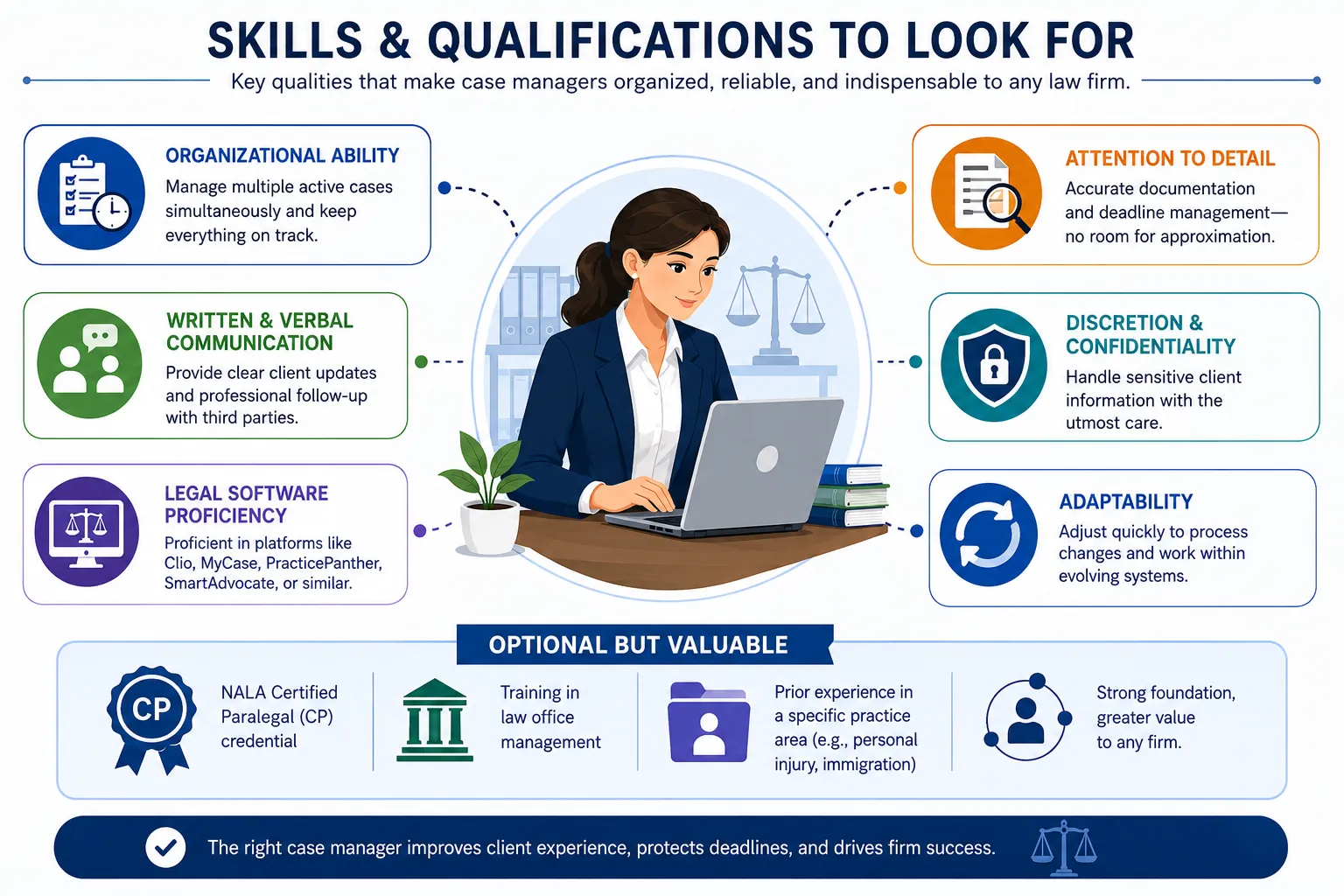
Skills and Qualifications to Look For
Not every person with legal experience is well-suited for case management. The role requires a specific combination of operational and communication skills.
- Organizational ability: Managing multiple active cases simultaneously without losing track of where each one stands.
- Written and verbal communication: Clients need clear updates. Third parties need prompt, professional follow-up.
- Legal software proficiency: Familiarity with Clio, MyCase, PracticePanther, SmartAdvocate, or similar platforms is a practical requirement.
- Attention to detail: Deadlines and documents leave no room for approximation.
- Discretion and confidentiality: Handling sensitive client information is part of every day.
- Adaptability: Firm processes change. Case managers who adjust quickly and work within evolving systems are far more effective.
Optional but valuable: NALA Certified Paralegal (CP) credential, training in law office management, or prior experience in a specific practice area like personal injury or immigration.
Why Law Firms Are Choosing Remote Case Managers
A remote case manager handles the same tasks as an in-office hire. The work happens over email, phone, video calls, and shared software platforms. The location is different; the output is not.
For law firms, the difference shows up in cost and coverage.
According to Glassdoor's Legal Case Manager salary data based on 48 U.S. submissions as of December 2025, the average annual salary for a legal case manager is $60,463, before benefits, office space, equipment, and employer taxes. Remote case managers for law firms start at $15 to $16 per hour, with no long-term contracts or overhead costs.
Cloud-based case management software makes remote coordination fully workable. Case managers can keep files current, respond to clients, and follow up with third parties without any loss of visibility for the attorney.
For high-volume personal injury practices managing dozens of active files, delegating case coordination to a remote case manager is a practical way to protect attorney time without growing in-house headcount.
Frequently Asked Questions
What are the main duties of a legal case manager?
A legal case manager handles client intake, case file organization, deadline tracking, client communication, document preparation, and third-party coordination so attorneys stay on legal work.
Is a case manager the same as a paralegal?
No. Paralegals focus on legal research, drafting pleadings, and litigation support. Case managers focus on case coordination, client communication, and administrative workflow management.
Can a case manager work remotely?
Yes. Remote case managers perform all the same functions using shared platforms, email, and phone. Many personal injury and immigration firms use this model as their primary support structure.
What qualifications does a legal case manager need?
Most firms look for two or more years of law firm experience, proficiency in legal case management software, strong communication skills, and attention to detail. NALA certification is a plus.
How does a case manager help attorneys bill more hours?
By taking over intake, client updates, file management, and third-party follow-up, a case manager frees attorneys to focus on billable legal work rather than coordination tasks that fill most of the day.
How Case Managers Fit Into a Well-Run Law Firm
A legal case manager covers the coordination work that runs through every active matter: intake, file management, deadlines, client updates, and third-party follow-up. Attorneys handle the legal strategy. Case managers handle everything that keeps the case moving around it.
The role works in-office or remote. It fits solo practices as much as it fits mid-size firms. What determines whether it works is how clearly the responsibilities are defined and how consistently the case manager owns them.
If you are evaluating whether your firm needs this role, start with a simple question: how many hours per week does your attorney spend on tasks a non-attorney could handle? That answer usually makes the decision straightforward.








.webp)




.webp)


%20(1).webp)






















%20(2)%20(2).avif)
.avif)