
A theft lawyer's case outcome often hinges on one thing: whether the right document was filed before the clock ran out. Legal case management for theft attorneys is the systematic tracking of every task, document, court date, and client interaction from intake through final resolution.
Theft cases are distinct. They require proving or disproving criminal intent, tracking property valuations that can shift a charge from misdemeanor to felony, and securing time-sensitive evidence like retail surveillance footage before it is deleted. Without a structured workflow, critical steps fall through the cracks.
What follows is a phase-by-phase breakdown of how theft defense firms should organize their workflow, which documents belong at each stage, and which deadlines carry the highest risk when missed.
Key Takeaways
- Retail surveillance footage is deleted within 24 to 72 hours. Send preservation requests at intake.
- Property value documentation can shift a charge from felony to misdemeanor. Track it from day one.
- Missing a motion to suppress deadline waives the argument permanently.
- Flag expungement eligibility at case close, not when the client follows up months later.
What Makes Theft Case Management Different from Other Criminal Cases
Theft cases create a specific set of documentation and timeline demands that other criminal matters do not. The core issue in any theft charge is criminal intent. To prove or disprove it, the defense must build an evidentiary record at every phase, not just at trial.
Property valuation adds another layer. A single receipt or appraisal record can change the charge classification entirely. Case managers need to flag the applicable threshold immediately at intake and track it through the entire discovery phase.
Thresholds vary significantly by state. Texas sets the felony line at $2,500, while California and New York set it at $950 and $1,000 respectively. Case managers should verify the operative threshold for their jurisdiction at intake. See the NCSL state-by-state felony theft threshold resource for a full breakdown.
Theft caseloads at criminal defense firms are growing. Firms without a structured legal case management process are handling more files with the same overhead, and the risk of error compounds with volume.
Evidence types in theft cases also tend to be retail-specific. Surveillance footage from stores, loss prevention incident reports, and point-of-sale transaction records all have short retention windows or require formal preservation requests to hold. General criminal defense software settings may not account for these, which is why theft-specific workflow templates matter.
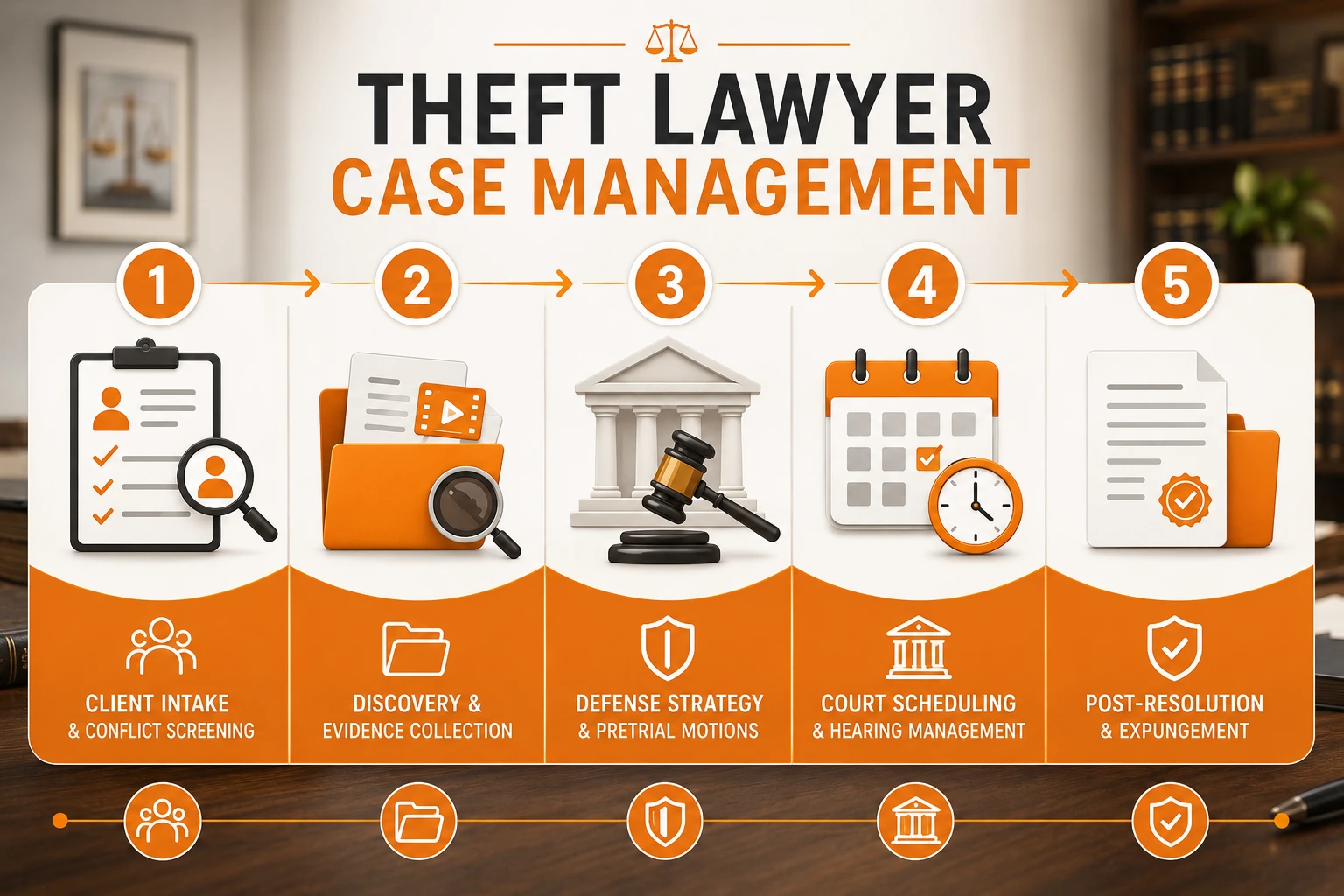
Phase-by-Phase Workflow for Theft Attorneys
Phase 1: Client Intake and Conflict Screening
The intake phase sets the evidentiary and financial foundation for the entire theft defense. A poorly structured intake form misses details that affect charge classification, defense strategy, and fee structuring from day one.
What to collect at intake:
- Alleged property value and description of item(s)
- Store name, location, and arresting agency
- Arrest context (was a warrant involved? Was there a pursuit?)
- Client's prior criminal record, if any
- Whether surveillance footage exists and who holds it
What to configure in your case management system:
- Flag charge tier (misdemeanor vs. felony) based on property value entered
- Trigger automatic conflict check against retail businesses, loss prevention officers, and opposing parties in the system
- Generate retainer agreement and fee structure based on charge classification
- Send immediate evidence preservation letter template to the case manager's task queue
Conflict checks matter more in theft cases than attorneys often expect. Large retailers, loss prevention agencies, and certain prosecutors' offices are recurring parties. Running a client against existing files on day one prevents complications that surface during trial prep.
Phase 2: Discovery and Evidence Collection
Discovery in theft cases is time-sensitive. Retail surveillance footage is typically deleted within 24 to 72 hours unless a formal preservation request goes out immediately after intake.
Beyond preservation, the discovery phase requires careful tracking of prosecution disclosures (often referred to as Brady material) to ensure favorable evidence is provided.
Case managers must log the receipt dates of all prosecution disclosures and monitor strict disclosure deadlines. This log provides the evidence needed to trigger a timely motion to compel, preserving the defense attorney's objection rights. Missing that filing window permanently closes the argument.
Core discovery tasks for theft case managers:
- Log each piece of evidence with chain-of-custody notes and storage location
- Track the valuation of alleged stolen property against state felony thresholds
- Organize alibi documentation: geolocation data, transaction records, and merchant receipts
- Monitor prosecution's disclosure deadlines and calendar a motion to compel if materials are not received
Phase 3: Defense Strategy and Pretrial Motions
The strongest pretrial motions in theft cases target evidence obtained without proper authority. Missing the filing window kills that argument permanently, regardless of its merit.
Defense teams should categorize each file by primary strategy line as early as possible. This is not just a planning exercise. It drives which motions get drafted, which experts get retained, and which witnesses the investigator prioritizes.
Four primary defense categories for theft cases:
- Lack of Intent: The defendant did not knowingly take property belonging to another person
- Mistaken Identity: The defendant was misidentified through surveillance footage, eyewitness error, or circumstantial evidence
- Good Faith Borrowing: The defendant believed they had permission to take or use the property
- Unlawful Search and Seizure: Evidence was obtained without a valid warrant or through an improper stop
Pretrial motion tracking tasks:
- Schedule motion to suppress based on the court's scheduling order, issued after arraignment
- File omnibus motion covering Brady requests, motions in limine, and motions to compel in one window
- Track pre-trial diversion program enrollment if the client qualifies (first-time offense, low property value)
- Monitor diversion milestones: anti-theft class completion dates, community service hours logged, and restitution payments made
For diversion cases, the case manager's calendar becomes the client's compliance record. If a milestone is missed, the diversion collapses and the original charge is reinstated.
Phase 4: Court Scheduling and Hearing Management
Court date management in theft cases requires rules-based calendaring, not manual entry. One missed appearance triggers a bench warrant and adds charges to an already active case.
Calendaring rules for theft defense firms:
- Pull jurisdiction-specific windows for arraignment, pretrial conference, and trial date at intake
- Set multi-channel reminders (text, email, and client portal) at 14 days, 7 days, and 48 hours before each appearance
- Calculate speedy trial windows by state and monitor them actively. Florida updated Rule 3.191 effective July 1, 2025, which adjusted misdemeanor trial windows to 90 days. Florida’s Rule 3.191 is cited here as an example, every state has its own speedy trial statute, and case managers must calendar the jurisdiction-specific window for each active file.
- Log all plea stipulations, restitution payment schedules, and probation conditions with calendar triggers for each compliance date
Plea agreement management is often underestimated as a case management task. A missed restitution payment can trigger a probation violation, which creates new court dates and additional exposure. The case is not closed when the plea is entered. It is closed when every condition has been satisfied and documented.
Phase 5: Post-Resolution and Expungement
Expungement eligibility should be flagged at case close, not months later when the client calls asking why their record still shows up in background checks.
Theft convictions carry long-term consequences for employment, housing, and licensing. Proactive post-resolution management is a client retention and referral driver for the firm.
Post-resolution workflow tasks:
- At case close, trigger an expungement eligibility check based on outcome (dismissal, not-guilty, reduced plea)
- Log the applicable state waiting period before a petition can be filed (typically 1 to 3 years)
- Set a calendar reminder for the petition filing date
- Notify the client proactively when they become eligible
Documents needed for expungement:
- Case disposition order
- Sentence completion proof or compliance certification
- Court-specific petition forms
- Any required agency notification documents
Key Documents Every Theft Case File Requires
Every phase of a theft case generates specific documents. Missing any one of them at the wrong moment can create procedural gaps that affect admissibility, compliance, or plea validity.
- Intake: Signed retainer, conflict check log, fee agreement, arrest report, evidence preservation letter
- Discovery: Surveillance footage log, Brady material request, property valuation record, alibi timeline, chain of custody notes
- Pretrial: Motion to suppress, omnibus motion filings, diversion enrollment forms, diversion milestone log
- Court: Plea agreement, sentencing order, restitution payment schedule, appearance confirmation records
- Post-Resolution: Dismissal or verdict order, expungement petition, waiting period calendar trigger, record sealing proof
Deadlines Theft Lawyers Cannot Miss
These are the filing windows that directly affect a theft client's outcome. Each one is non-negotiable.
- Evidence preservation request: Send within 24 hours of intake when retail or third-party surveillance is involved.
- Formal charge filing window: Prosecutors typically have 48 to 72 hours post-arrest on misdemeanors to file. Defense tracks this to challenge unlawful detention.
- Discovery request deadline: Filed within the scheduling order window set after arraignment. Missing it can waive the right to compel production of evidence.
- Motion to suppress deadline: Set by the court's scheduling order, typically 30 to 60 days post-arraignment depending on jurisdiction.
- Speedy trial monitoring: Speedy trial monitoring: Florida’s updated Rule 3.191 (July 2025) sets a 90-day misdemeanor window. Every jurisdiction applies different speedy trial rules, so deadline tracking must remain state-specific.
- Pre-trial diversion milestones: Program-specific. The case manager tracks class completion, community service hours, and restitution payments against program-set dates.
- Restitution payment schedule: Post-plea. Missed payments can constitute a probation violation and reopen the case.
- Expungement petition filing: Triggered after the state-specific waiting period expires, typically one to three years post-resolution.
Legal Case Management Software for Theft Defense Firms
The right legal case management software does more than store files. It enforces deadlines automatically and structures the defense workflow from the first intake form to the final expungement petition.
MyCase launched MyCase IQ in October 2024, adding document summarization and natural language case queries. CARET Legal's workflow automation assigns tasks and flags deadlines without manual input, which is particularly useful for firms running parallel theft dockets at different charge tiers.
No software replaces the human judgment needed to manage a theft defense, but it does remove the administrative risk that creates procedural errors.
How a Remote Case Manager Supports Theft Defense Operations
Theft defense firms carrying high caseloads often reach a point where attorneys are spending more time chasing documents and monitoring deadlines than building strategy. That is where a remote case manager trained in criminal defense workflows addresses a real operational gap.
What a remote case manager handles on theft files:
- Sends evidence preservation letters immediately after intake is completed
- Logs discovery items with chain-of-custody notes in the firm's case management platform
- Tracks diversion program milestones and flags missed compliance dates before they become violations
- Monitors speedy trial windows and pretrial motion deadlines by jurisdiction
- Triggers expungement workflows the day a dismissal or not-guilty verdict is entered
- Coordinates client reminders across text, email, and portal for every scheduled court appearance
Remote case managers at Remote Case Manager work inside your existing software, whether that is MyCase, CARET Legal, Filevine, or PracticePanther. There is no equipment cost and no extended onboarding. Firms using remote case management support consistently report lower overhead compared to equivalent in-house hiring, particularly when factoring in benefits, equipment, and training costs.
For theft defense firms managing misdemeanor and felony files simultaneously, having dedicated case management support is the difference between a clean docket and a liability exposure. Learn more about how this model works in practice in the Remote Case Manager vs. In-House Staff: An Actual ROI Comparison and in the guide to avoiding common mistakes when adding remote staff to your law firm.
Frequently Asked Questions
What documents does a theft lawyer need to manage?
A theft attorney manages arrest reports, surveillance logs, evidence preservation letters, Brady requests, property valuation records, motion filings, plea agreements, and expungement petitions. Each maps to a specific phase and deadline.
What is the most critical deadline in a theft defense case?
The evidence preservation request is the most time-sensitive step. Retail surveillance footage is deleted within 24 to 72 hours. Missing it eliminates potential exculpatory evidence before the defense can review it.
What is legal case management in criminal defense?
It is the systematic tracking of all case tasks, documents, court dates, and client communications from intake to resolution, including strategy mapping, motion scheduling, and post-resolution expungement workflows.
Can a remote case manager work on theft defense files?
Yes. Remote case managers trained in criminal defense workflows handle deadline tracking, document organization, client follow-up, and court calendar management inside platforms like MyCase or Filevine. They manage the operational layer, not the legal strategy.
What software do theft defense attorneys use for case management?
MyCase, CARET Legal, PracticePanther, Filevine, and CosmoLex are the most widely used platforms. The right choice depends on firm size, caseload volume, and whether integrated billing or trust accounting is a priority.
The Bottom Line on Theft Case Management
Managing theft cases well is an operational discipline, not just a legal one. Every missed deadline, unfiled motion, or unsent preservation letter is a recoverable mistake only if someone catches it before the window closes.
Firms that build a structured legal case management workflow, supported by the right software and trained case management staff, run tighter dockets, protect client rights more consistently, and reduce their own liability exposure. For criminal defense practices where theft cases are a significant part of the caseload, that structure is not optional.








.webp)




.webp)


%20(1).webp)






















%20(2)%20(2).avif)
.avif)