
Attorney burnout is not a personality problem. It is a capacity problem. When a firm takes on more cases than its team can realistically handle, deadlines slip, clients complain, and good attorneys leave.
According to a 2022 American Bar Association survey, 52% of lawyers reported high levels of burnout and overloaded caseloads are one of the leading contributors. The firms that avoid this outcome are not the ones with the most attorneys. They are the ones with the best systems.
This guide covers what healthy caseload management looks like, how to spot when yours is broken, and the steps firm managers can act on right now.
Key Takeaways
- A lawyer's ideal caseload depends on practice area. Trial attorneys generally cap at 30 to 70 active matters; complex litigation attorneys often limit themselves to 12 to 15.
- Both overloaded and underloaded caseloads hurt firm performance. The goal is sustainable throughput, not maximum volume.
- According to the Clio 2024 Legal Trends Report, the average attorney bills only 2.9 hours out of every 8-hour workday. Non-billable tasks consume the rest.
- Delegating routine case tasks to trained support staff is the most direct way to recover attorney capacity without hiring more lawyers.
What Is a Caseload in Law?
A caseload is the total number of active legal matters an attorney or firm is managing at any given time. It includes every case at every stage: new intakes, active litigation, pending negotiations, matters in discovery, and cases approaching close.
Managing that inventory is what caseload management refers to. It is the practice of controlling new intake, prioritizing active matters, and building systems so each case gets adequate attention.
It is not just a scheduling concern. Caseload size directly affects billing capacity, client outcomes, malpractice exposure, and whether attorneys can sustain their careers long-term.
How Many Cases Can a Lawyer Handle at Once?
There is no universal number. The right caseload size depends on practice area, case complexity, available support staff, and the firm's workflow systems.
High-volume firms that carry 200 to 300-plus cases do not manage that load through attorney effort alone. They rely on paralegals, intake automation, standardized workflows, and dedicated case coordinators.
What Is Your Caseload Capacity?
Use this formula as a starting point: divide your available annual billable hours by the average hours each case requires.
Example: An attorney billing 1,600 hours per year, with cases averaging 20 hours each, can theoretically manage about 80 active matters. In practice, urgency and complexity shift that number. Use it as a floor, not a ceiling.
Signs Your Firm's Caseload Is Out of Balance
Most firms do not realize their caseload is a problem until a deadline is missed or a client files a complaint. These are the earlier warning signs.
Your caseload is too high if:
- Attorneys are working evenings and weekends as a routine, not an exception
- Clients are not receiving timely updates on their cases
- Filing deadlines are being tracked in personal calendars or spreadsheets
- Cases are sitting untouched for two or more weeks
- Support staff is completing tasks that belong to attorneys because there is no other option
Your caseload is too low if:
- Support staff is underutilized or doing work outside their job description
- Revenue is inconsistent and cash flow gaps are widening
- Attorneys are handling their own administrative work
- The firm has no structured intake pipeline to replace closing matters
Both situations cost firms money. An overloaded firm risks malpractice exposure and attorney turnover. An underloaded firm loses revenue and competitive standing.
The 80/20 Rule for Lawyers
The 80/20 rule, or Pareto Principle, applies directly to law firm caseloads. In most practices, roughly 20% of cases generate 80% of firm revenue. That same 20% often demands a disproportionate share of attorney time.
Applied to caseload management, it means three things:
- Not all cases deserve equal attorney attention. High-value, complex matters need more direct involvement.
- Routine, lower-complexity cases can be handled effectively with standardized processes and trained support staff.
- Auditing which cases consume the most resources regularly helps identify where delegation would have the most impact.
A managing partner who reviews their active case list with this lens will usually find several matters that can be moved down the priority tier or reassigned without affecting client outcomes.
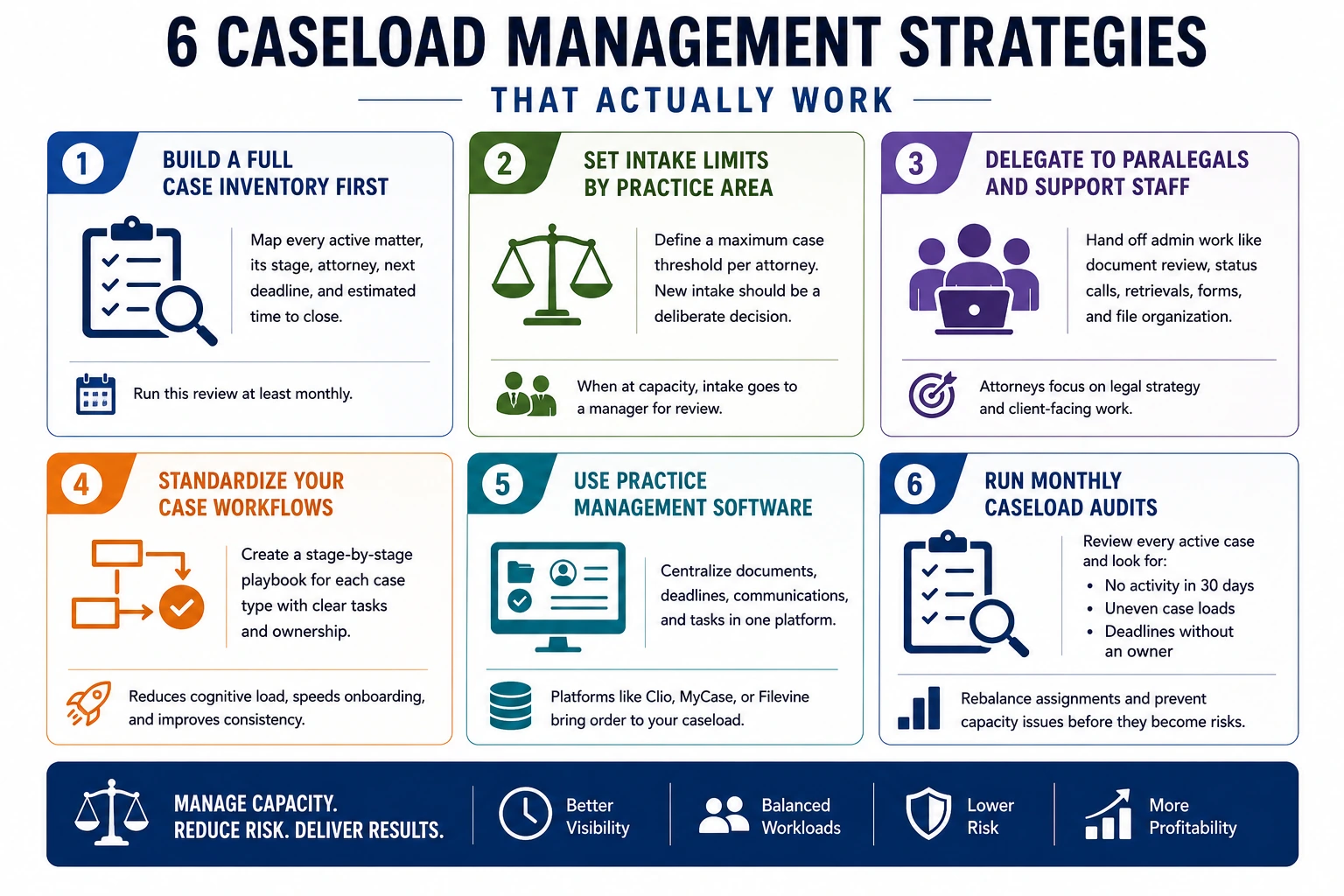
6 Caseload Management Strategies That Actually Work
1. Build a Full Case Inventory First
Before you can manage your caseload, you need to see it clearly. Map every active matter, its current stage, assigned attorney, next deadline, and estimated time to close.
Run this review at least monthly. Cases go unattended when no one has a view of the full picture.
2. Set Intake Limits by Practice Area
Define a maximum case threshold per attorney for each practice group. New intake should be a deliberate decision, not a default yes.
When an attorney is at capacity, the intake decision should go to a manager for review. It should not simply get added to an already full caseload.
3. Delegate to Paralegals and Support Staff
The Clio 2024 Legal Trends Report found attorneys bill just 2.9 hours of every 8-hour workday. The remaining hours go to administrative tasks, many of which do not require a law license.
Document review, client status calls, medical record retrieval, court form preparation, and file organization belong with trained support staff. Attorneys should be focused on legal strategy and client-facing work that genuinely requires their expertise.
4. Standardize Your Case Workflows
Build a stage-by-stage playbook for each case type your firm handles. Every team member should know exactly what tasks belong to each stage and who is responsible.
Standardized workflows reduce cognitive load on attorneys, speed up onboarding for new staff, and allow anyone to pick up a case file without having to start from scratch.
5. Use Practice Management Software
Centralizing documents, court deadlines, client communications, and task assignments in one platform removes the biggest source of caseload chaos: information scattered across email inboxes, spreadsheets, and personal notes.
Practice management platforms like Clio, MyCase, or Filevine handle this centralization. The right choice depends on your firm's size and practice areas.
6. Run Monthly Caseload Audits
Set aside 30 to 60 minutes monthly to review every active case. Look for:
- Matters with no activity in the past 30 days
- Attorneys carrying significantly more cases than their colleagues
- Upcoming deadlines with no assigned owner
Rebalance assignments based on what you find. This habit prevents small capacity issues from becoming malpractice risks.
How Remote Case Managers Help Law Firms Manage More Cases
The most direct way to recover attorney capacity is to remove routine case tasks from their workload entirely. That is what a remote case manager for law firms does.
Remote case managers handle the operational side of the case lifecycle: client status updates, medical record retrieval and organization, insurance correspondence, document preparation, intake coordination, and deadline tracking. Attorneys stay focused on the legal work that requires their training.
For personal injury firms, this is especially valuable. PI cases involve high volumes of documentation, ongoing medical coordination, and frequent client communication. A trained remote case manager handles that operational layer at a fraction of the cost of a full-time in-house hire.
Firms using remote legal case management services report significant improvements in case handling capacity and overall efficiency, while saving an average of $56,000 annually per hire compared to in-house staff.
If your attorneys are spending hours on tasks that do not require a law license, that is the place to start. See how remote case managers reduce lawyer burnout and how other firms have scaled without adding full-time headcount.
Frequently Asked Questions
What is caseload in law?
A caseload is the total number of active legal matters an attorney or firm is managing at one time, including every case at every stage from intake through close.
What is considered a caseload?
Any active client matter counts: open litigation, pending negotiations, matters in discovery, and cases awaiting filing. All contribute to an attorney's caseload and workable capacity.
How does caseload work?
Cases enter through intake, get assigned to attorneys or teams, move through defined stages (intake, discovery, negotiation, resolution), and close when the matter is resolved. Caseload management means controlling flow across all active matters simultaneously.
What is the 80/20 rule for lawyers?
It is the Pareto Principle applied to legal practice. Roughly 20% of cases generate 80% of firm revenue. Applying it means prioritizing high-value matters for attorney attention and delegating or standardizing the rest.
How many cases can a lawyer handle at once?
It depends on practice area. Litigation attorneys typically carry 30 to 70 cases. Complex civil litigators often limit to 12 to 15. High-volume personal injury firms run 200 to 300-plus active cases with strong support systems and delegation structures in place.
Build the System Before You Hit the Wall
Caseload management is rarely a priority until the problems are already visible: missed deadlines, attorney overtime becoming the norm, and clients calling because no one has been in touch.
The firms that scale without burning out their teams share a few things in common. They set intake limits, they delegate with intention, they audit regularly, and they invest in support structures that let attorneys work on what they were trained to do.
If you are a managing partner or firm owner watching case volume grow while your team is already stretched, the answer is rarely to ask more from your attorneys. It is to build the right system around them.








.webp)




.webp)


%20(1).webp)






















%20(2)%20(2).avif)
.avif)