
Contract backlogs slow down every part of a legal team's work. Missed renewals, buried clauses, and scattered files cost real time and money. Contract lifecycle management (CLM) software fixes this with one system to draft, approve, sign, store, and track every agreement.
This guide covers what CLM software does, top platforms for 2026, pricing, and how to pick the right one for your team.
Key Takeaways
- CLM software manages a contract from drafting to renewal in one system, replacing scattered emails and shared drives.
- Most legal departments now have a dedicated legal operations role, and contract management sits at the center of that work.
- CLM pricing ranges from under $50 per user monthly for small teams to custom enterprise quotes for large legal departments.
- Match the platform to your contract volume and team size first. Feature lists matter less than fit.
What Is Contract Lifecycle Management (CLM)?
Contract lifecycle management is the process of handling a contract from request through renewal or termination. It covers six stages: creation, negotiation, approval, signature, storage, and tracking.
Before CLM tools existed, legal teams ran this process through email, spreadsheets, and paper files. That breaks down fast as volume grows. World Commerce & Contracting's 2023 Benchmark Report found contract data at mid-size and large businesses spans an average of 24 separate systems, making obligations hard to track. The same report found nearly 30% of a company's workforce touches contracts at some point.
Legal operations teams increasingly own this problem, since contracts sit at the intersection of legal risk, revenue, and compliance.
What Is CLM Software?
CLM software is the technology that runs the contract lifecycle process above. It replaces manual tracking with one connected system. World Commerce & Contracting estimates enterprises leak 3% to 9% of contract value through unclear terms and missed obligations, a gap CLM software closes.
Most CLM platforms include:
- A centralized contract repository with search
- Workflow automation for approvals and routing
- Built-in or integrated e-signature
- A clause and template library
- AI-based contract review and data extraction
- Renewal and obligation alerts
- Reporting dashboards
Modern platforms in 2026 go further than older tools once did. Many now use AI to flag risky clauses, forecast renewal timing, and summarize long agreements in seconds. Firms building out their document workflows can also review this list of legal document management tools to see how CLM fits alongside broader case and file management systems.
CLM Software vs. Basic Contract Management Software
Not every contract tool covers the full lifecycle. Some only handle storage, while others manage the process from drafting through renewal.
Basic contract management tools store and organize signed agreements in a searchable repository. They work well for firms that just need a reliable filing cabinet, but they rarely include drafting, approval workflows, or AI-based review.
Full CLM software manages the process end to end: drafting, approval routing, e-signature, AI clause review, and renewal tracking, all in one system. It costs more and takes more setup, but it replaces several disconnected tools with one workflow.
If your team only needs a searchable filing cabinet, basic tools work. If you need to manage the entire process, CLM software is the better fit.
Best Contract Lifecycle Management Software for 2026
These platforms were shortlisted for AI capability, adoption ease, integrations, and fit for legal teams.
Juro
Built for legal and commercial teams handling high contract volumes, with fast browser-based editing.
Pros: Quick to signature, easy for sales and legal to share one workflow, flexible setup
Cons: Custom pricing only, less suited to very small teams
Summize
Embeds contract workflows into tools teams already use, like Teams and Slack.
Pros: Easy adoption for non-legal staff, low learning curve, strong for distributed teams
Cons: Fewer standalone features than enterprise platforms, custom pricing only
Icertis Contract Intelligence
An enterprise-grade platform covering authoring, negotiation, execution, and renewal at scale.
Pros: Deep compliance and governance tools, built for high contract volume, strong AI features Cons: Higher cost, longer implementation, likely more than small firms need
LinkSquares
Combines AI-powered analytics with a full CLM workflow.
Pros: Strong reporting on obligations and key terms, good for in-house legal teams
Cons: Custom pricing only, analytics depth can be more than smaller teams use
Docusign CLM
Extends Docusign's e-signature strength into full lifecycle management.
Pros: Easy fit for firms already on Docusign, familiar interface, solid workflow tools
Cons: AI features are lighter than some competitors, add-on cost on top of e-signature plans
ContractSafe
A repository-first platform with strong search, OCR, and reminders, plus growing workflow tools.
Pros: Simple to use, lower starting price, good for smaller legal teams
Cons: Workflow automation is less advanced, AI features still developing
You can compare platform reviews on Gartner Peer Insights before shortlisting a vendor.
Key Features to Look for in CLM Software
- Centralized repository: contracts stored and searchable
- Approval routing: clear sign-off paths before execution
- E-signature integration: native or connected, not manual
- Clause library: approved language ready to reuse
- AI clause extraction: flags risky or missing terms
- Renewal alerts: notice before a deadline, not after
- Audit trail: a record of every edit and approval
How to Choose CLM Software for Your Legal Team
Match the tool to your contract volume and team size before comparing features.
- Count your monthly contract volume and complexity
- List the tools you need it to integrate with
- Decide how much AI review you actually need
- Ask vendors about implementation timelines
- Confirm security and compliance certifications
Smaller firms managing this process without dedicated staff may also want to look at this roundup of tools and software used to run day-to-day legal operations.
CLM Software and Legal Operations
CLM software is one part of a larger legal operations stack. It works alongside intake, billing, and case communication systems, not in isolation. According to the Thomson Reuters Institute's 2025 Legal Department Operations Index, 82% of legal departments now have at least one dedicated legal operations role, and contract management typically sits at the center of that work.
Firms adopting CLM often hit a second bottleneck as volume rises: someone still has to review incoming matters, organize supporting documents, and keep case files moving. This is where our remote case managers for law firms step in, handling intake, document organization, and follow-up. Review our case management services and pricing, or reach out directly to talk through your setup.
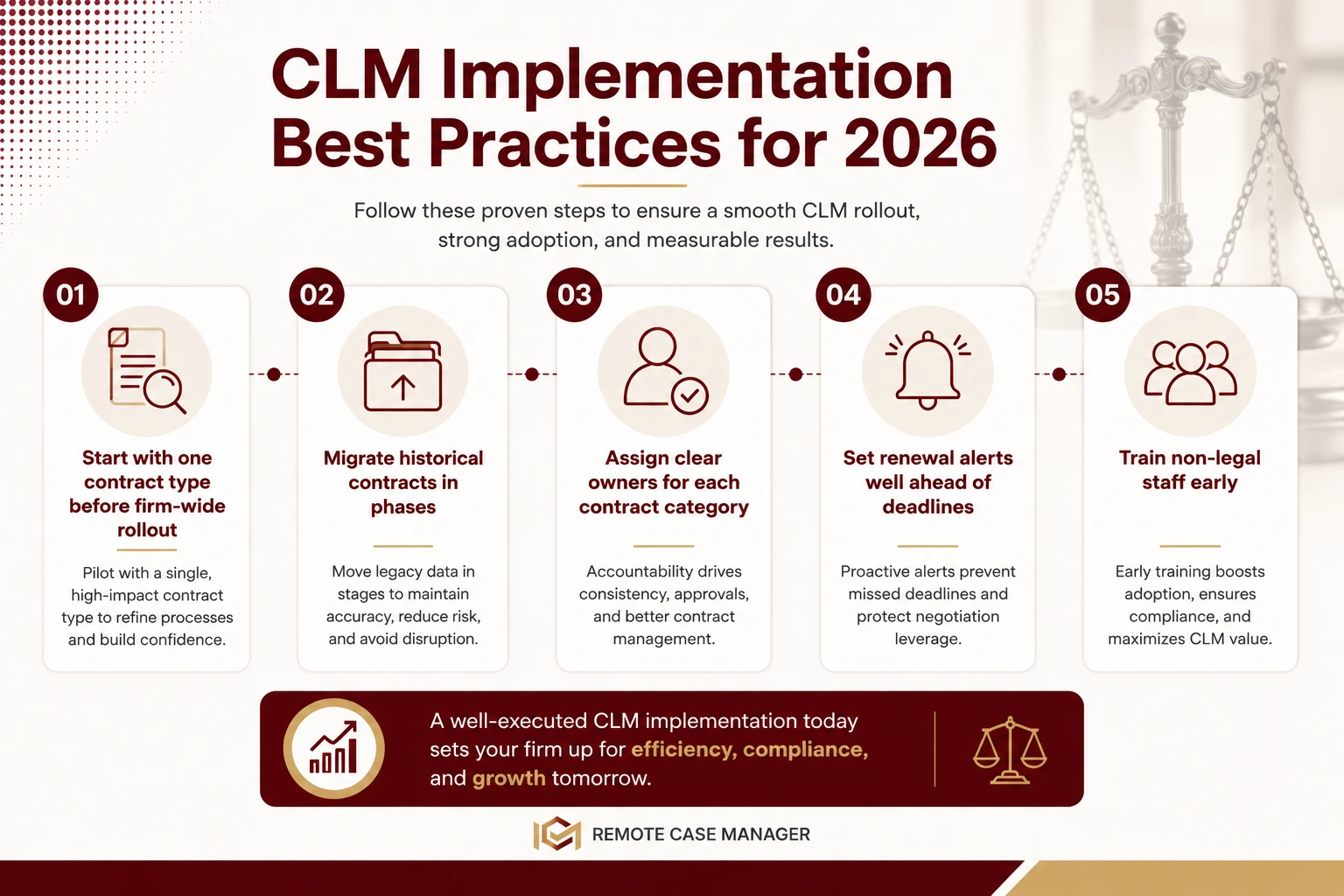
CLM Implementation Best Practices for 2026
- Start with one contract type before firm-wide rollout
- Migrate historical contracts in phases
- Assign clear owners for each contract category
- Set renewal alerts well ahead of deadlines
- Train non-legal staff early
Frequently Asked Questions
What is a CLM?
CLM stands for contract lifecycle management. It covers every stage of a contract, from drafting and negotiation through approval, signature, storage, and renewal tracking.
What is contract lifecycle management software used for?
Legal and business teams use CLM software to speed up approvals, reduce missed renewals, and keep every contract version and obligation visible in one searchable system.
Is CLM software worth it for small law firms?
Yes, especially once contract volume grows. Small firms can start with lower-tier, repository-first plans and add workflow automation as caseloads increase.
What's the difference between CLM and e-signature software?
E-signature software only handles signing. CLM covers the full process, including drafting, approval workflows, clause libraries, storage, and renewal tracking.
Does CLM software use AI in 2026?
Most modern CLM platforms now include AI features for clause extraction, risk flagging, and renewal forecasting, though the depth of those features still varies by vendor.
Choosing the Right CLM Platform for Your Firm
The best contract lifecycle management software depends on your contract volume, team size, and how much AI review you need. Smaller firms can start lean with repository-first tools, while larger legal departments benefit from enterprise platforms built for scale.
Whichever platform you choose, CLM works best as one piece of a connected legal operations setup, not a standalone fix. Pair it with reliable intake and case support, and your team can move contracts and cases forward together.








.webp)




.webp)


%20(1).webp)






















%20(2)%20(2).avif)
.avif)